Before the Last Yards
Team USA won the 2026 Backyard Ultra World Team Championship with 1,120 yards. It also had the slowest average lap among all 67 nations and led only during the final 37 yards. Belgium’s Geerts and Steyaert reached 124 yards, the farthest anyone had run at this championship, while their team finished third. Taken together, those results complicate the familiar assumption that the champion must be the fastest.
The discussion began with a short community post, collected at about 68 upvotes and eight comments, and continued on a public analysis page titled “The middle wins.” The post, comments and analysis concern one championship. They offer a way to read its results, not a pacing prescription for every backyard ultra. They also leave individual race details and splits unstated.
The slowest average, a late lead
A backyard ultra starts a loop each hour, usually about 6.7 kilometres or 4.167 miles. Runners must complete it within the hour to remain eligible for the next start. Miss the limit and you are out. A “yard” here means one loop.
Running talk often treats faster laps and shorter averages as proof of seriousness or dominance. Peak athletes draw attention; leading from start to finish makes an easy championship story. The United States’ result resists that neat version. The slowest average coexisted with the title, and leading only for the last 37 yards still ended in a total of 1,120.
Each number describes something different. Average lap time concerns speed. The timing of a lead describes the race’s progression. Accumulated yards concern the team result. Picking only the most striking measure can turn a team championship into a story about its most visible runner.
What the tenth runner tells us
“The middle wins” looks at full teams with at least 12 runners. Its argument is that the tenth runner’s performance often correlates more closely with team placing than the performance of the team’s best runner. That shifts attention toward the people who keep the team accumulating yards beyond the spotlight.
A commenter adds an early-race comparison. Over roughly the first 40 yards, while the leading nations still had their runners in, the US averaged about 52:21 per lap. Australia averaged about 47:25, Belgium 48:20 and Japan 48:32. In that comparison, the US was around 3:49 to 4:56 slower per lap.
The figures make the discussion more useful than another celebration of peak performance. How far the strongest runner goes and how long the tenth runner lasts are separate questions. Recognising the middle does not require dismissing the stars.
Nor does “the slowest team won” establish that going slowly guarantees a win. One commenter asks readers to account for elevation gain on the US loop. Course conditions and individual differences remain relevant, and an average over the first 40 yards cannot tell every runner’s story. An explanation of this result is not a tactic everyone can copy.
Belgium’s 124 yards and third place
Geerts and Steyaert took the championship’s farthest distance to 124 yards. The progression runs from 75 to 101, then 110 and now 124. Belgium’s team nevertheless finished third.
In the supplied thread, a high-scoring comment calls Belgium the real heroes: a small nation with great trail events and lovely, crazy people. Another calls Merijn and Ivo legends. Those reactions express what spectators admired. They do not automatically amount to an argument that Belgium should have received the team title.
Individual distance and team placing deserve to be understood separately. Admiring 124 yards does not require disputing the American win. Accepting the standings does not stop people seeing heroes in the third-placed team. The elevation reminder, likewise, deserves attention without becoming a complete explanation for every difference in pace.
Keep the measures distinct
This discussion gives independence a practical meaning. When someone says a champion must always be fastest, look again at average lap time and accumulated yards. When someone says slow always wins, bring course conditions and team depth back into the picture. Neither speed nor slowness needs to become the only acceptable virtue.
If you fear that running slowly makes you look unserious, keep that fear separate from what the race data show. Admiration in the comments can be moving, and the analysis of the tenth runner can change how you watch a race. Neither removes the conditions particular to someone else’s performance.
The next time a championship photograph catches your eye, it is worth asking how long the less visible teammates kept going. Your own next backyard ultra will still require decisions that fit your body and your course.
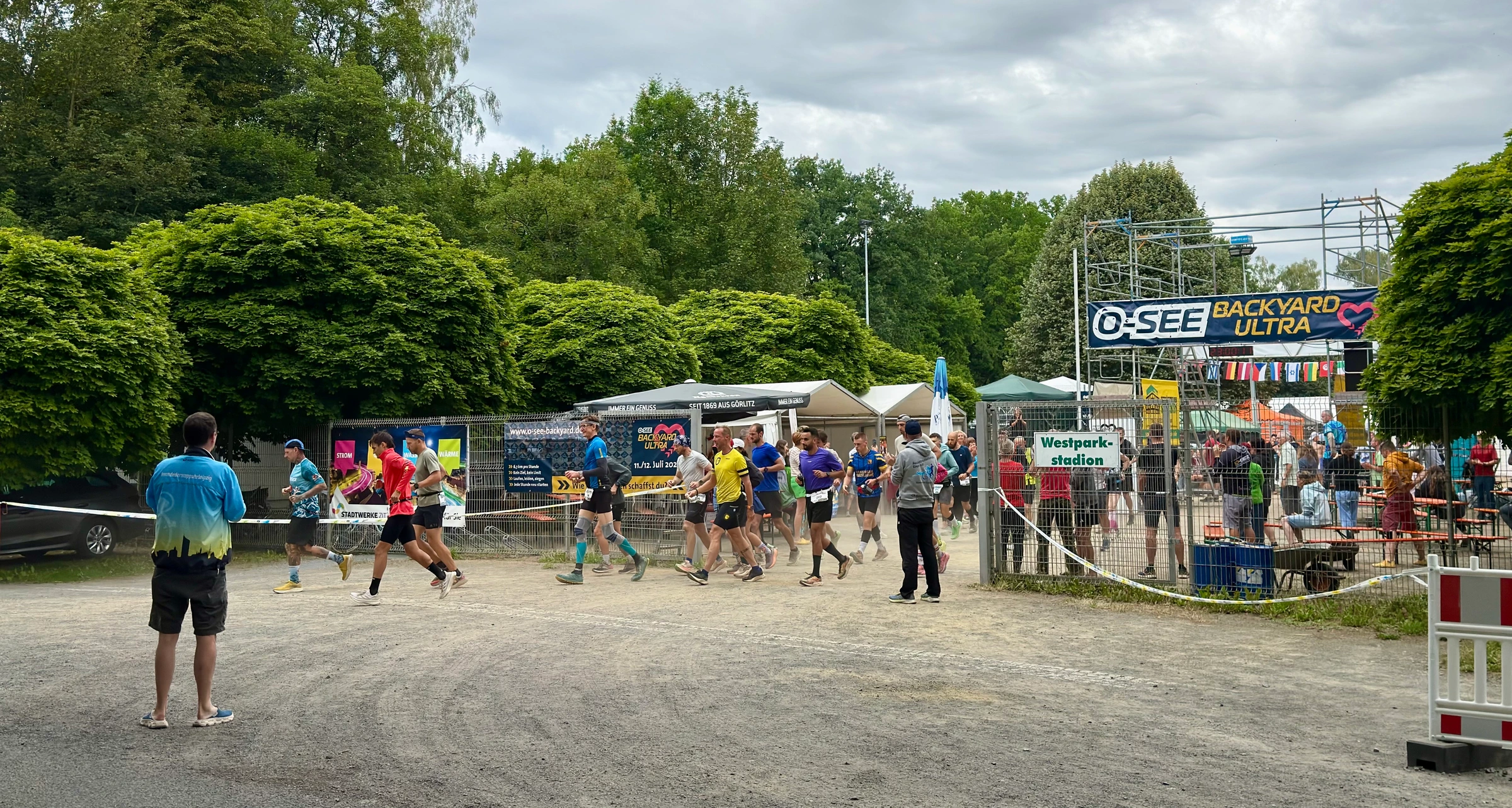
O-SEE Backyard Ultra, Zittau, Germany, July 2026. Illustration of the format, not the WTC race discussed here. Olgierd Rudak · CC BY-SA 4.0 · https://commons.wikimedia.org/wiki/File:O-SEE_Backyard_Ultra_Zittau_(2026-07-12)_1.jpg · https://creativecommons.org/licenses/by-sa/4.0/
