Abs in half an hour lying down? What is Emsculpt Neo selling?
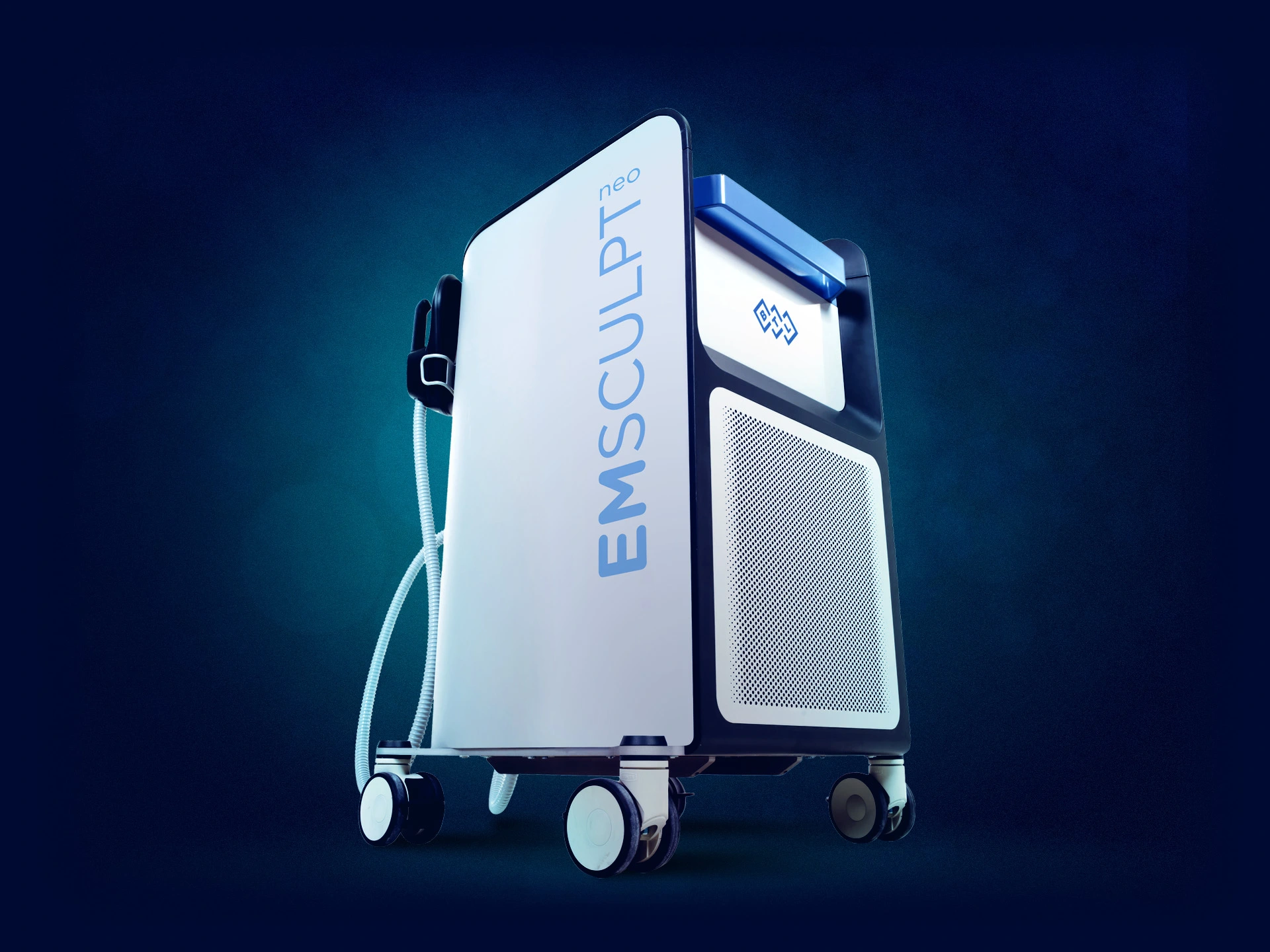
“Build muscle and lose fat while lying down” is a familiar aesthetic-treatment pitch. Emsculpt Neo, from Czech company BTL, belongs to this category of non-invasive body contouring. I compared the manufacturer's descriptions, clinical research and independent commentary to understand what it changes and what those percentages measure. Local contours, body weight, long-term training and metabolic health are separate questions.
One applicator, two forms of energy
Emsculpt Neo combines high-intensity focused electromagnetic technology, HIFEM, with synchronized radiofrequency, RF. The first induces muscle contractions; the second heats local tissue. According to the manufacturer, RF warms the muscle and brings subcutaneous fat to roughly 42–45°C, while electromagnetic stimulation produces what it calls supramaximal contractions. Changes following fat-cell heating develop over subsequent weeks and months. This explains the manufacturer's proposed mechanism, not the result any individual can expect.
The original Emsculpt primarily uses electromagnetic stimulation; Neo adds synchronized RF. BTL describes sessions of about 30 minutes, commonly four sessions spaced roughly five to ten days apart. Listed areas include the abdomen, flanks, buttocks and thighs; its contouring page mentions people with a BMI up to about 35. Actual treatment areas and indications depend on local authorization and assessment.
The manufacturer describes intense contractions and warmth, likening the heat to a hot-stone massage, and says downtime is generally unnecessary. Some accounts mention soreness afterward. Experiences and tolerance vary; “no downtime” does not mean nobody will feel discomfort.
Percentages and millimetres measure different things
BTL highlights about 25% muscle growth, 30% fat reduction and 87% patient satisfaction. These are results from research cited by the manufacturer, not maximum effects or individual guarantees. A 30% reduction does not mean losing 30% of body weight or a guaranteed change in waist size.
An upper-arm MRI study by Jacob and colleagues enrolled 34 participants for four weekly, 30-minute bilateral treatments. Among 28 participants assessed at one month, mean muscle thickness increased about 21.5% and fat thickness decreased about 22.3%. Among 25 assessed at three months, the respective changes were about 23.9% and 25.5%. Body weight was essentially unchanged. These measurements concern local tissue thickness, and fewer people completed follow-up than initially enrolled.
An independent review pooling Emsculpt and Emsculpt Neo literature reported abdominal imaging changes on the order of 5.5 mm less fat thickness and about 2 mm more muscle thickness. Its author questioned photographic effects, measurement methods, sample sizes and manufacturer relationships. Converting striking percentages into millimetres helps put their possible scale in context.
A later independent commentary also discussed equipment costs and cited a historical suggested patient charge of about US$3,400 for four treatments. That is pricing information in the literature, not a current Chinese clinic quote. A photograph after treatment cannot establish how long an effect lasts or whether further sessions will be needed.
Contouring and rehabilitation have different indications
In October 2024, BTL announced additional FDA clearance involving rehabilitation uses of neuromuscular stimulation in the limbs, including prevention of disuse atrophy, muscle re-education and maintaining or increasing range of motion. Additional rehabilitation indications do not mean the FDA guarantees every contouring claim.
The FDA explains that non-invasive body contouring is not intended to treat obesity or reduce body weight. Pregnancy, implanted electronic devices, metal or other implants near the treatment site, and local skin problems should be disclosed during assessment. Risks and contraindications differ by technology. The specific device instructions and professional assessment matter; one online exclusion list cannot serve all three machines.
Comparison one: CoolSculpting cryolipolysis
CoolSculpting includes different devices, such as Elite. It uses cryolipolysis to address local fat bulges, with changes developing over subsequent months. Its official material has cited a small study of ten people showing up to roughly 20–25% reduction in the treated fat layer at two and six months, with six participants represented at six months. It does not itself build muscle.
The experience can include suction, cold and subsequent numbness. Redness, swelling, soreness or altered sensation may persist afterward. Official safety information also lists paradoxical adipose hyperplasia, PAH: a firm, enlarged fat bulge can develop in the treated area and may require surgery. Estimates vary with studies and counting methods. “Rare” does not mean impossible.
The American Society of Plastic Surgeons' average fee for non-surgical fat reduction covers multiple treatments; it cannot be treated as a complete CoolSculpting quote for a particular body area. As of 28 October 2026, this article has not verified mainland Chinese clinic prices that match a specific device, area and course of treatment.
The comparison with Neo is straightforward. CoolSculpting focuses on fat contours; Neo promotes changes in both fat and muscle. Suitability still depends on the person's tissues and assessment. Wanting more visible abs alone does not determine the choice.
Comparison two: Cutera truFlex electrical muscle stimulation
Cutera's truFlex, previously called truSculpt flex, uses Multi-Directional Stimulation, MDS. Pads deliver electrical stimulation through a different route from Neo's electromagnetic technology. The official site describes sessions as short as about 15 minutes, with different stimulation modes and coverage of multiple muscle groups, mainly for sculpting the abdomen, buttocks and thighs.
truFlex does not incorporate synchronized RF fat reduction into the same treatment. Cutera pairs it with a separate truSculpt RF device when presenting its truBody approach. A two-device plan should not be understood as one device's price or treatment schedule.
Patient-platform price ranges and maintenance intervals mentioned in the supplied manuscript vary by location, treatment area and plan. They are neither a universal price list nor a schedule everyone must follow. Comparable mainland Chinese clinic prices have not been verified here, so the article cannot establish which device is cheaper or more widely available there.
What are these treatments selling?
Neo offers combined effects on muscle and fat in one treatment; CoolSculpting focuses on local fat bulges; truFlex centres on muscle stimulation. Calling them interchangeable alternatives obscures their different targets. The original Emsculpt should also be distinguished from Neo.
These treatments may change local shape, but cannot take care of body weight, fitness and long-term health together. Identifying the actual device model, its locally authorized uses and the total treatment cost is more useful than relying on a headline percentage. This is an explainer about public information for understanding and comparison, not a promise of results or an individual treatment plan.
Sources
BTL Emsculpt Neo https://bodybybtl.com/solutions/emsculpt-neo
Upper-arm HIFEM and synchronized RF MRI study https://pmc.ncbi.nlm.nih.gov/articles/PMC10005810/
Swanson independent commentary https://pmc.ncbi.nlm.nih.gov/articles/PMC11776875/
FDA non-invasive body contouring information https://www.fda.gov/medical-devices/aesthetic-cosmetic-devices/non-invasive-body-contouring-technologies
Cutera truFlex https://cutera.com/us-en/products/truflex/
CoolSculpting FAQ https://www.coolsculpting.com/how-it-works/faq
This article is only for reading, reflection and personal judgment. It is not an instruction manual. It is simply part of the world as it exists.
Official BTL Emsculpt Neo device photograph. BTL · https://bodybybtl.com/solutions/emsculpt-neo · Original 1920×1440; WebP conversion, full aspect ratio.