Fluorine Ledger
Biohacking conversations can turn quickly into a list of things to add to the body. Another supplement, another addition to the stack, another sign that the person taking it is serious. The PFAS discussion in this account makes room for an ordinary activity instead. Could donating blood or plasma reduce some substances already circulating in us? The question deserves attention, along with the conditions attached to the answer.
PFAS, or per- and polyfluoroalkyl substances, are often called forever chemicals. They have been used in firefighting foam, nonstick cookware, carpets, clothing and water-resistant coatings. They persist, and have been detected in drinking water and human blood. Some bind to serum proteins, particularly albumin, which gives researchers a reason to investigate blood and plasma donation.
The supplied account brings together a Biohackers discussion, a research summary in The Conversation and a firefighter trial published in JAMA Network Open. The trial and the comments have different jobs here. One measures changes in concentration; the others show how occupational exposure, donation requirements and personal experience shape people's response.
What the thirty-percent figure includes
Funded by Fire Rescue Victoria and conducted with Macquarie University, the trial involved 285 firefighters and contractors with elevated serum PFOS. Participants were randomly assigned to donate plasma every six weeks, whole blood every twelve weeks, or make no donations during twelve months of observation.
Both donation groups reduced serum PFOS, with a larger reduction in the plasma group. The research summary described an average reduction in serum PFAS of about 30% for plasma donors, still observable three months after donations ended. That figure belongs to the trial's participants, measured compounds and follow-up period. It cannot stand for a universal reduction in every person's chemical burden.
The plasma group could donate up to about 800 milliliters at a time, compared with about 470 milliliters of whole blood, and donated more frequently. PFAS concentrations in plasma were roughly twice those in whole blood. Protein binding, volume and frequency all matter when interpreting why the plasma arm did better. Removing them from the comparison leaves an appealing claim with too little explanation.
Plasma donation also involved a more complicated, less comfortable procedure and lower adherence to the donation schedule. The study continued through the Black Summer bushfires and Melbourne lockdowns; 94% of participants completed the baseline and week-52 data collection. The fire service had replaced fluorinated foam and cleaned its trucks, but past exposure still mattered.
One question remained open. Would lower serum concentrations improve long-term clinical outcomes? That requires further research. A measurable reduction is a result to investigate, not a guarantee of better health.
Firefighters, recipients and a sauna claim
In the supplied discussion, one commenter said their fire department encouraged quarterly donations to reduce PFAS and carcinogen burden. Another, described in the account as having been retired for 25 years, had never heard of the approach and thought it was time to start. The blogger also mentioned coatings on protective gear, foam, drinking water, packaging, protein binding and paid plasma donation in the United States. These are accounts from the discussion, rather than statements on behalf of every department or donation service.
Someone asked whether donated blood would contain PFAS too. The explanation accompanying the research said Australian Red Cross Lifeblood allowed people with such exposure to donate, and that no PFAS threshold had been established as increasing recipient risk. The trial did not assess that risk. A commenter who had received a transfusion expressed a personal choice plainly: when blood was needed, blood containing PFAS was preferable to none.
The same discussion included a claim that sauna use could reduce PFAS by about 90%. Another commenter brought in a sweat study indexed in PMC and argued that it did not support that number. Others warned against putting a fitness influencer's experience of one above medical research. Rejecting an unsupported percentage does not require turning donation into an all-purpose solution.
The requirements belong in the account
The comments became more practical as they went on. One person argued that plasma eligibility was underestimated, mentioning tattoos, medication, residence distance and checks of temperature, blood pressure, hematocrit and protein at each visit. Others challenged the claim that only 10% of Americans qualified, saying many adults could donate blood. Those are competing comments; they cannot establish the rules of a particular donation service.
There were questions about microplastics from tubing, too. Some favored considering plasma mainly for people with high exposure, while seeing whole-blood donation as a positive option for others. Another commenter raised albumin, total protein and iron in connection with frequent donation. These concerns broaden the discussion beyond a PFAS reading, but do not amount to an individual donation plan.
Keeping the complications visible prevents a familiar substitution: a demand for a fuller supplement stack becomes a demand for more donations. Blood donation can have a place in biohacking conversations without excluding supplements or clinical advice. Each choice still needs evidence and an honest account of what remains unknown.
That is what the fluorine ledger is for. Six weeks and twelve weeks are different schedules; 800 and 470 milliliters are different volumes. The measured reduction belongs alongside the unanswered question about long-term benefit. Independent judgment has to accommodate those details. One more supplement, or one more detox slogan, cannot settle them.
The content of this article is only for viewing, reflection and independent judgment. It is not an instruction manual. It is simply a part of what exists in the world.
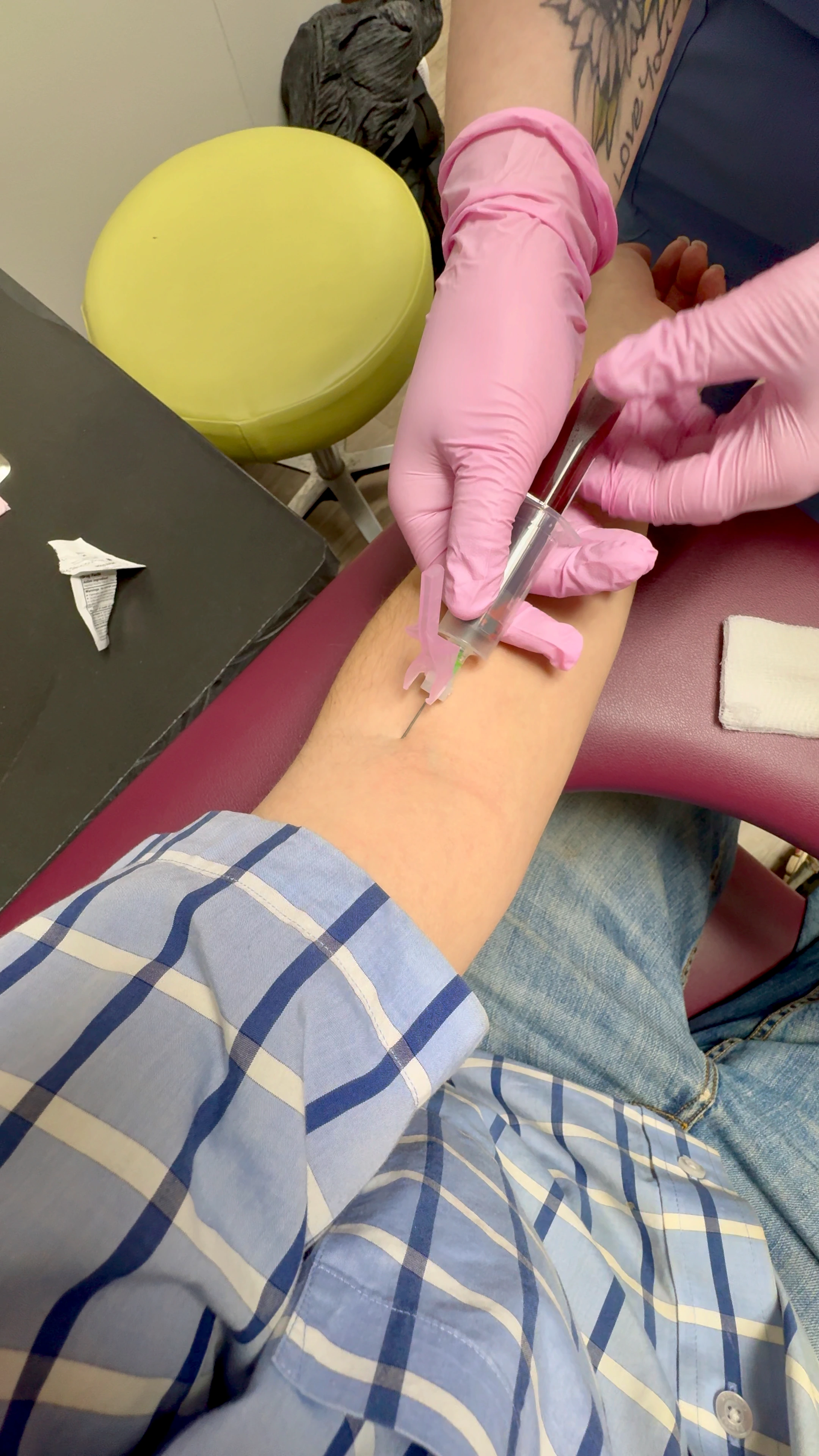
Illustrative venipuncture photograph, not a scene from the trial. Harrison Keely / Wikimedia Commons / CC BY 4.0. https://commons.wikimedia.org/wiki/File:Drawing_blood_from_a_vein_through_phlebotomy_and_venipuncture.jpg https://creativecommons.org/licenses/by/4.0/ Full frame retained; resized and compressed to WebP.
