Climbing per Kilometre: Another Measure of Trail Difficulty
If, over the past decade-plus, the spectrum of mass trail and ultra culture was still drawn as a straight line—with “hard because long” on the left and “brand epic equals steepest” on the right—then once someone divided cumulative climb by distance across more than two hundred eighty European public races and laid “meters of elevation per kilometer” on a table, that line had already folded into a pair of scissors: one blade is the almost absurd vertical density of short mountain races; the other is the epic loops of three hundred kilometers and beyond that still press gradient talk under mileage myth. The image running through this discussion is not the next longer finish certificate, but the tide of gradient and the knife-edge of epic: on one side, how a vertical tide of roughly eighty meters per kilometer cuts open the default that “hard = long”; on the other, the comment section’s nearly unanimous reminder—average grade ≠ difficulty, and the blade still needs half an inch more.
From “hard because long” to “elevation per kilometer”: how the default gets overturned
What the blogger did was plain: using public course data, divide D+ (cumulative climb) by distance to get D+/km (meters per kilometer), deliberately stripping out “hard because long.” The sample lands on two hundred eighty-seven European trail races. The method itself almost invites a fight with the industry default—the default says epic equals long, long equals hard; the table says: once length is pulled out, the definition of steep changes hands.
The ranking table’s scenes are concrete enough. The 52 km Glen Coe Skyline, about 4,280 m of D+, about 82.3 D+/km, sits at the top; the 144 km Échappée Belle about 76.4; the 360 km Swiss Peaks Trail about 73.9; the 93 km GR20 Nord Ultra Trail about 73.1; the 330 km Tor des Géants about 72.7; the 450 km Tor des Glaciers about 71.1. Further down, the 31 km Sierre-Zinal also sits around 71.0—able to match epic races at ten times the mileage. Salomon Ultra Pirineu is written as a 60 km tier at about 68.3; and the hugely famous UTMB, by the same metric, lands around 58 m/km—not especially steep.
This narrative is familiar in trail circles: finish posters love “hundreds of kilometers, twenty thousand meters of climb”; brand epics love stacking absolute mileage and absolute climb into myth; short afternoon mountain races get casually filed under “festival runs” or “vertical kilometer” side branches. The post overturns the default not by denying long distance, but by changing the ruler: ask first how much elevation each kilometer lifts, then talk about hard. The blogger’s surprise is honest—the 52 km Glen Coe Skyline outranks Tor des Géants and Swiss Peaks on D+/km; 31 km Sierre-Zinal can still match epics at ten times the distance. The surprise holds because the ruler changed; it is also dangerous, because the ruler itself has not yet been cut open by the comments.
82.3 versus 58: why the short-steep tide still cuts the UTMB myth
The numbers in the post speak for themselves. 82.3 against about 58: on one side, nearly continuous steep rises and drops on a Scottish Highland ridge; on the other, the Tour du Mont Blanc epic’s cultural default as “one of the hardest.” Vertical density and horizontal myth collide here—the tide is written in meters per kilometer; the myth is written in finish narratives and media spectrum. The industry default shows its seam again: it assumes “hard” can be derived losslessly from “long”; the comments and the table rewrite it with the same public data—what is truly steep may be the vertical tide squeezed into short races, not forever outsourced to the “300 km+” epic label. UTMB around 58 m/km does not diminish the Mont Blanc loop; it only refuses to cash fame directly into “also steepest by elevation per kilometer.”
Press the scene further: if the calendar holds both “30 km-class steep” and “300 km-class long,” yet finish narrative rewards only the latter, training and race choice get swallowed by horizontal myth—short-steep becomes warm-up, long-gentle becomes ultimate. Criticism beyond the top likes already cuts in: average grade is not difficulty; short afternoon mountain races and multi-day epics cannot share one stage; some propose metrics closer to energy cost (NOLS energy miles and similar). These objections do not cancel D+/km; they remind that the tide can cut myth but cannot alone crown a god.
Loops, finish elevation, and discontinued names: half an inch of data blade
The comment section did not follow the comfort story that “the ranking is final truth.” One commenter (~32 upvotes) questioned generative traces and noted that no Ultra Pirineu 60 km tier exists in the calendar—the common local distances are around 100 km and the like; there never was a 60. One row on the table thus slides from “verifiable fact” toward “half an inch of data blade”: however clean the method, one wrong input writes the tide onto the wrong shore.
Another commenter (~8 upvotes) added two steeper scenes—PicaPica about 110 km / 11,500 m; Trail du Besso about 59 km / 5,800 m—and called Sierre-Zinal “cheating”: the finish sits far higher than the start, while many others are loops or more balanced undulation. That sentence pulls the profile back from the average into geometry: net climb, loop descent, one-way lift can masquerade as the same steepness on one D+/km ruler. Another comment mentioned Gran trail Courmayeur 100k at about 100 km / 7,400 m; a Pyrenees-side commenter reported local steep-race numbers (Trail Valle de Tena, Canfranc, and so on)—scenes, not an encyclopedia of undetailed facts.
One more reminder must sit in parallel: a comment (~5 upvotes) said Glen Coe Skyline is no longer held. Public Skyrunning-type pages had still listed the name around 2023 at about 51 km / 4,563 m climb—the name remains in the difficulty spectrum; whether it is still raced is another matter. The text need not pretend to adjudicate “does it still count”; it only needs to present both: the top of the list can be a discontinued name; the myth can be a brand still running; half an inch of blade sits in those two cracks.
Together these comments do not deny the blogger’s intuition (vertical density really can cut “hard = long”); they refuse to read “data trail” as “forever covering the course with the next ranking.” The through-image therefore drops from “gradient tide” to “the knife still in the sheath must discern profile before drawing half an inch”: verify whether distance tiers truly exist, ask loop versus finish lift, ask whether the race is still held, ask whether average grade has swallowed technical terrain and multi-day recovery—all half an inch, yet enough to bring race choice from myth back to profile.
Closing: rewriting “independence” as holding both blades of gradient and epic
If mass trail culture often reads independence as “signing up alone for a longer epic” or “memorizing brand difficulty myths alone,” this discussion is closer to another independence—holding at once the tide of elevation per kilometer and the knife-edge of epic narrative, refusing a false binary. The blogger’s table matters because it lays verifiable scenes on the table (287 races, D+/km, Glen Coe ~82.3, UTMB ~58, short races matching tenfold mileage); the comments matter because they did not push the blogger into “ranking equals truth,” but spoke the spirit of the rule back: first verify inputs (do race names and distance tiers exist), then verify geometry (loops, finish lift, net climb), and with profile, technical trail, and multi-day load, still polish the epic blade inside the rising short-steep data—epic hardness often hides in recovery, sleep deprivation, and cumulative consecutive days, not only in meters per kilometer.
The actionable tip is plain: when you read the next race calendar, look at profile and D+/km, not only the poster’s total mileage and total climb; compare short-steep and long epic on separate stages, rather than crowning with one average; verify whether the race is still held, whether a distance tier was miswritten, whether start–finish elevation difference wrote “steep” into one-way lift; train both vertical density and consecutive-day recovery and fueling rhythm—write “hard” as “you can read both blades of gradient and epic,” not “forever outsourced to the next longer brand myth.”
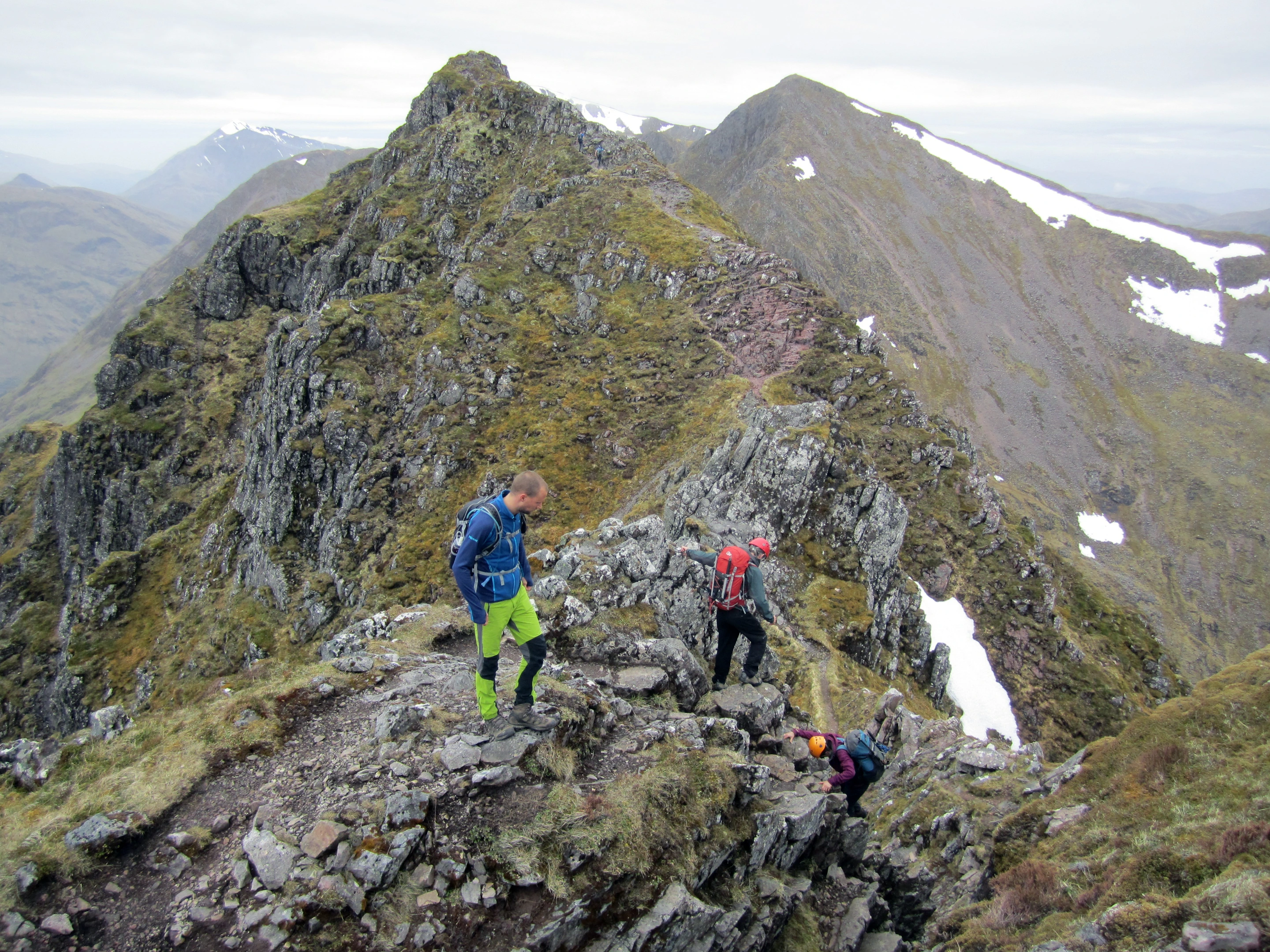
Aonach Eagach ridge, photograph by portengaround · CC BY-SA 2.0 · https://creativecommons.org/licenses/by-sa/2.0/
https://www.flickr.com/people/78981276@N03
https://commons.wikimedia.org/wiki/File:Aonach_Eagach_Ridge_(17890034319).jpg

Full frame retained; converted to WebP.