Impossible Sunrise Without a Seat
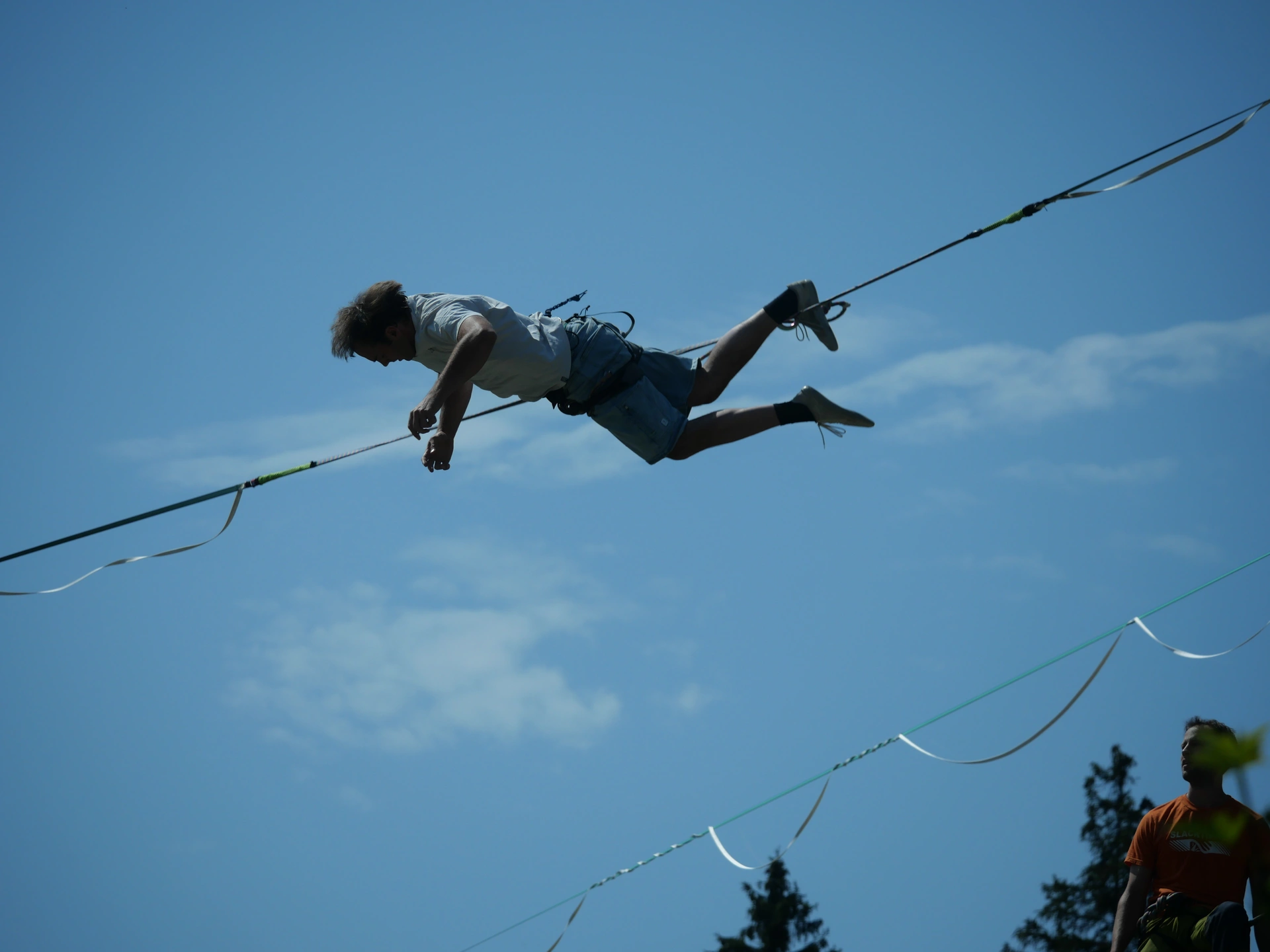
If, over the past decade or so, the spectrum of slackline (a taut flat webbing people walk or stand on) in ordinary life was still drawn as a straight line—on the left, “world champion means high-altitude tricks and short bursts”; on the right, “hold steady for a few minutes and snap a highline selfie and you have arrived”—then when Davis Hermes placed a twenty-four-hour no-sitting goal, the then-continuous standing record of about eighteen hours, and a second-night self-account of 18.5 hours still short of twenty-four side by side on the table, that line had already folded into two: one called tricks; one called a time ledger. The image that runs through this discussion is not the next easier slogan of “extreme challenge” or the next brighter proof of “world champion,” but an impossible sunrise without a seat: it shows that a record sometimes is not about flying higher, but about whether you can wait the sun out of the night on the bill of soles and attention; it also shows that the gap between 18.5 and 24 is not a slogan, but whether a pair of feet is still willing to keep paying.
Boundary first: scenes here come from a blogger’s public retelling of a video self-account, a beat sheet of that video, and checkable background such as Vail Daily—not a census of every slackline record or endurance challenge. It is useful because it presses “world champion” from high-air demo into the felt fact of not being allowed to sit; it is limited because it covers one person, two consecutive nights of attempts, and one step-off short of twenty-four hours.
A slackline set up in a park. Used to contrast: the default writes champion stories as high tricks; this attempt nails the ledger to time you cannot sit through.
Default logic: write the world champion in the sky first, then in short bursts
Industry default likes to write slackline champion stories as a high-air handbook: highlines between hot-air balloons, freestyle between cliffs, burst power at world championships. The default holds in many shop windows—until you unfold Davis Hermes’s attempt. Per the video self-account, the goal was blunt: stay on a slackline for twenty-four hours; the continuous standing world record then was about eighteen hours; and he called himself zero-experience in endurance challenges—this was the first. Rules were earthy: walking and standing allowed; sitting not; no borrowing balance from another person; food and water allowed (Heather handed food); he even considered solving bathroom needs on the line rather than stepping off.
Background can stay light. Reporting such as Vail Daily has noted: he started after seeing a demo at the 2012 Mountain Games in Vail, later took world titles, and walked highlines between hot-air balloons. That material serves the spectrum—showing the “trick champion” label is not empty—but the tension of this attempt is not “he flew again,” it is how the label tears. Default assumes a world title automatically covers “how long can you stand”; the scene says—for him, balance may already feel like flat ground; what smashes the default is the time ledger of not being allowed to sit.
What this section really measures is not whether high air deserves awe, but: when the record rewrites from “fly once” into “twenty-four hours without sitting,” is the champion card in the viewer’s hand still enough?
A highline scene. The left of the spectrum often writes champions as high tricks; this attempt asks the same feet to serve a sunrise you cannot sit through.
First night: distraction fall; second night: almost no sleep, back on
If “world champion” is easy to read as “of course he can stand forever,” the two-night timeline tears that ad open. First night about eight hours: while dealing with leg chafe, adjusting underwear and a glove, he lost focus and fell—framed in the self-account as a slightly silly miss, not a dramatic collapse. Next day, little sleep, back on. Neck, shoulders, back tight; toes numb and tingling; mental fatigue from the night before still hanging on. Friends kept him company (names such as Sammy Colon, Jimmy Harry, Heather appear in the materials); pizza arrived in foil; overnight care was handed to friends; around 3 a.m. he was still optimistic about sunrise; sunrise was treated as a milestone; a breakfast burrito reached the line; the hours before sunrise were written as the hardest stretch.
At about 18.5 hours he stepped off: soles felt crushed, he needed a bathroom, and he felt a long way still remained—so the attempt ended short of twenty-four. A week-later edit added: tape marks every twenty-five feet to count laps; about 1,225 laps, roughly 61,250 feet, about 18.67 km / 11.6 miles. He also compared Tibor’s prior continuous distance (Tibor also about eighteen hours, about 14.8 km) and Taimen’s distance inside a twenty-four-hour window that allowed stepping off (about 16 km)—framing himself as aiming at one continuous twenty-four-hour goal while claiming three records along the way; this essay treats that only as video self-account contrast, not an official leaderboard verdict.
His self-critique is blunt: stacking two nights cost him; he beat the eighteen-hour record by under half an hour; he still believes better prep could reach twenty-four; he thanks the support crew. One commenter summed the second night as “unhinged”—funny, and accurate: this was not an ultra-style taper finish, more an impulse record stacked on fatigue that had not cleared.
Public thumbnail from the attempt video (source: YouTube). First night ~8 hours, distraction fall; second night little sleep, ~18.5 hours.
How the comments reweigh “18.5”: balance tax, prep, and the joke line
If the blogger keyed the story to “broke eighteen hours,” the comments immediately hand over harder conditionals. One commenter, who has run 103 miles in twenty-four hours, wrote: you vastly underestimate the accumulated physical and mental exhaustion of being on your feet that long, let alone on a slackline where you constantly adjust balance—twenty-four hours already sounds insane; thirty-six is far more than twice as hard. On the other side, commenters fix on “zero prep + eight hours the night before”: some bet that retrying a week later would hit twenty-four easily; with a little endurance training, even thirty-six seems thinkable for a two-time highline freestyle world champ—and they trust that for him, balance on this line barely differs from walking flat ground.
Both sides side by side are what the discussion really measures. Default either writes 18.5 as “a champion casually stands and breaks a record,” or as “short of twenty-four means it does not count”; the scene says—the same attempt stacks zero endurance experience, back-to-back fatigue, the attention tax of constant balance, and the counterfactual of “with systematic training, maybe longer.” Joke lines also appear: bathroom and pants riffs, jokes that record circles will always contain someone willing to stake face on wilder rules. Those jokes can be touched lightly—they show the community heard “cannot step off” as real—but need not become a vulgar center; what stays nailed to the ledger is soles and attention, not the bit itself.
A highline between rock faces. Comments contrast “103 flat miles” with “constant balance on webbing”: the same “no sitting,” different bill thickness.
Closing: redefine “independence”—not a higher trick, but holding the no-seat rule and the second-night cost of the miss
If slackline culture often reads independence as “one person plasters a world-champion card across the sky before talking about anything else,” or “one person believes 18.5 is bright enough without asking what twenty-four still costs,” this discussion is closer to another independence—holding at once the rule of “no seat” and the cost of the second-night miss, and seeing that the gap between 18.5 and 24 is not a slogan but a bill of soles and attention. The open discussion the blogger laid out is worth public writing because it puts checkable scenes on the table: twenty-four-hour goal; continuous record then about eighteen hours; self-described zero endurance experience; walk/stand yes, sit no, no borrowed balance, food allowed; first night ~8 hours, distraction fall while adjusting glove/underwear; next day little sleep; tight neck/back, numb toes; friends chatting, foil pizza, overnight handoff, sunrise milestone, breakfast burrito; hardest hours before sunrise; ~18.5 hours off for crushed soles and bathroom need; later lap count ~18.67 km; self-critique that two nights cost him, record margin under thirty minutes, still believes prep could reach 24; and comments weighing the 103-mile contrast, no-prep madness, training that might go longer, and joke lines kept light.
The value of the discussion is that it does not push only “everyone should stand twenty-four hours” or “short of twenty-four means nothing,” but talks the spirit of challenge back: first separate “trick champion” from “time ledger,” then “impulse consecutive nights” from “ultra-style prep,” and with “impossible sunrise without a seat” and “second night on almost no sleep” still polish, inside the rising tide of “of course a champion can stand longer” and “almost doesn’t count,” the layer that independence’s difficulty often hides in whether you still treat the next higher highline photo as your only body history—not only in the next easier “he broke the record” or the next brighter “only 5.5 hours short.”
A usable prompt is plain: treat “cannot sit” as the rule itself, not as a footnote to tricks. If you also want a long-stand or long-focus challenge, ask first whether the first night’s miss cost is written into the second night’s start conditions, before asking whether to stack a record on zero sleep. When you read “18.5 beats 18,” ask first on what fatigue floor the extra half hour was earned, then ask whether the gap to 24 is slogan or sole-bill. Keep someone else’s “train and you could hit 36” separate from your own “last night’s eight hours have not cleared”: testimony is not a license. Write “independence” as “holding the no-seat rule yourself”—allow breaking a record and missing twenty-four to be true at once; allow world-champion tricks and zero endurance experience to be true at once; the real danger is mistaking the champion card for a master key that ignores attention tax, or mistaking “almost” for a hard bar that erases bills already paid—not “forever outsourcing to the next easier of course he can” or “forever outsourcing to the next brighter short means nothing.” The sun will rise; an impossible sunrise without a seat is still written in whether you honestly recorded: in the hours from night into light, did the soles agree to keep paying. People who hold both the rule and the miss-cost at least know which lever they are measuring: trick height, or unsittable time.
Bricetofly · CC0 1.0 · https://creativecommons.org/publicdomain/zero/1.0/
https://commons.wikimedia.org/wiki/File:HWC_Laax_2026_-_Davis_Hermes_(1).jpg

Full original frame converted to WebP; aspect ratio retained.