Eighty-Eight Liters and Which Way the Door Opens: How Nitori Pulls the Solo Fridge Out of the “Shrunk Family Machine” Default
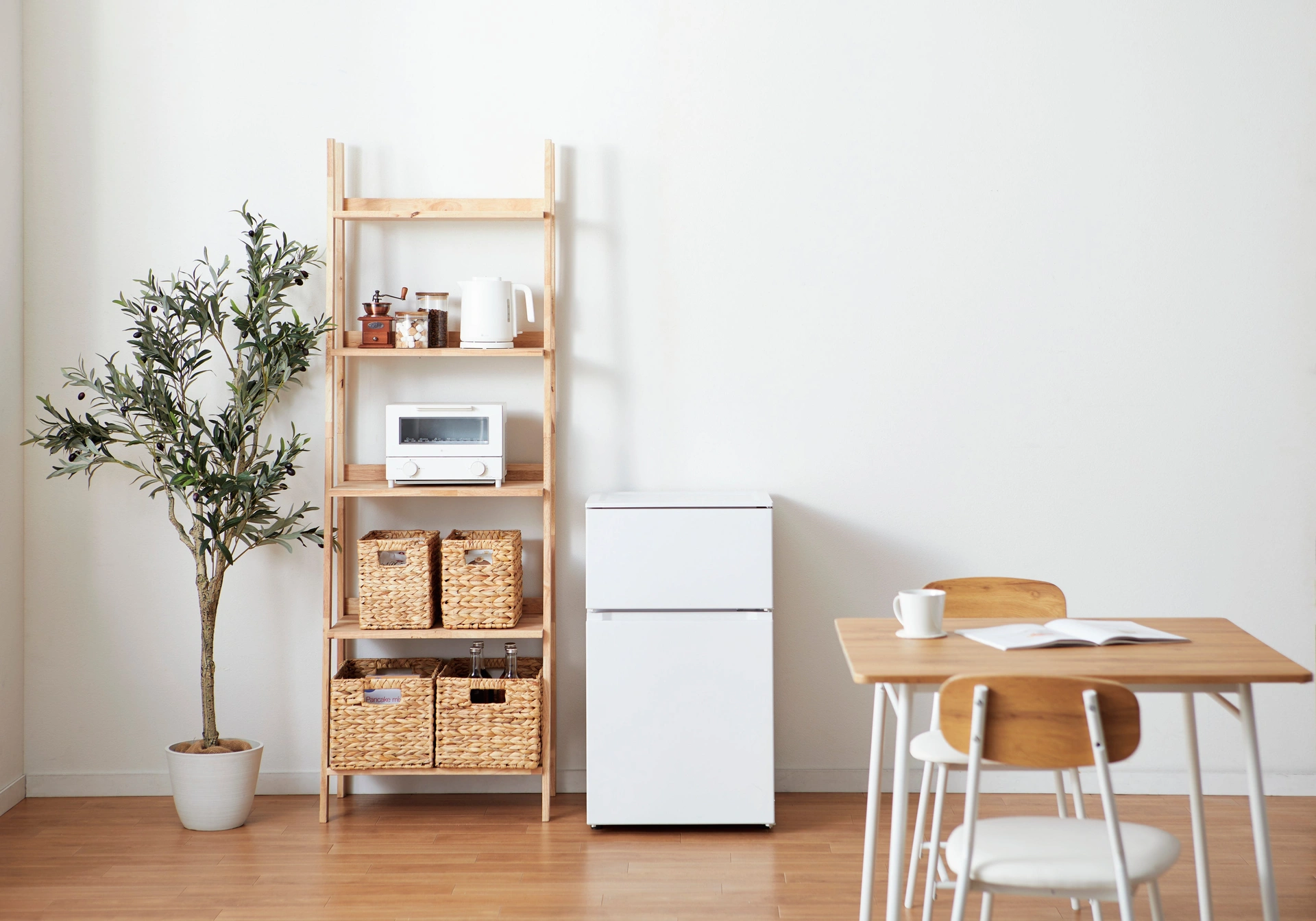
If the past decade-plus of Japanese home appliances still treated “living alone” as a scaled-down family fridge—capacity cut in half, door swing left to chance, body still shipped as if a center-kitchen French door belonged there—then this 88-liter direct-cool two-door unit in early 2026 finally designs around the wall gap and floor plan of a one-room flat, not around the prediction that “you will become a family soon.”
What runs through this piece are two equally plain numbers: a total volume of eighty-eight liters, and which way the door opens. They do not sound glamorous, yet they decide whether the machine can actually live in that one room—the strip of wall by the entry, the half-step beside the bed, the façade less than fifty centimeters wide next to the stove.
Solo cold-storage politics was never “can you afford a big fridge.” It is “does this machine assume you still lack half a wall, a door-swing radius clear to the opposite cabinet, and the habit of clearing stock only on weekends.” Family units often assume the hinge can be swapped later, that the top is only a lid, that the body should shine and announce itself. People who actually move in find the problem at move-in and at the first open—the door hits the bed edge, or a glossy cabinet turns the whole room into an appliance showroom.
From “enough capacity” to “the right swing”: the opening radius is the real threshold
Open any “must-have appliances for living alone” list and the fridge is almost always there. The industry line is easy: around a hundred liters for one person, two doors for convenience. Lists rarely ask the next question—does the door open right or left? And can you change it after install?
The usual answer is still kitchen inertia: volume first, power second, swing last—or even “swap the hinge after you buy.” In the store the machine looks solo-friendly; on site the door opens into the path—bed foot, vanity side panel, or the last turnaround in the corridor.
Nitori writes the problem the other way. Official specs: rated volume 88 L (fridge 63 L, freezer about 25 L); about W487 × D534 × H840 mm; mass about 26 kg; ¥24,900 tax-in. Only white and black—matte surface, square form, handles kept quiet, pitched as “flat & matte.” In a one-room flat that is not “quiet aesthetics”; it is one less reflective face stealing the eye.
The sharper footnote sits beside the door: right- and left-hinge models both exist, and the swing cannot be changed—you must match the floor plan before you buy. Family machines often treat “reversible hinge” as after-sales slack; a solo wall gap often cannot afford a second move. Writing “swing is fixed—measure the plan first” into the pitch admits that a one-person household is a full use case, not a waiting room for family life.
How eighty-eight liters split: sixty-three plus twenty-five, and a microwave on top
If swing solves “can it open,” daily life still turns on “can it hold today’s portion.” Industry talk loves “stock once, big.” Solo rhythm wants something concrete: a few days of bentos and vegetables in the fridge, a few packs of meat and a bag of ice in the freezer—not a warehouse for weekend parties.
Officially the fridge is 63 L and the freezer about 25 L; adjustable shelves and a vegetable drawer, door pockets three on fridge and one on freezer, pitched as easy to organize. That is not a parameter show; it admits solo food is small and fragmented and needs layers, not one big flat shelf.
The top plate is rated for a microwave—on a kitchen that is only one narrow counter, that stacks “heat” above “cold” and returns the counter to chopping and washing. Footnotes still apply: load and heat dissipation follow the manual. “Use the top” is a space claim, not a cancel of physics.
At ¥24,900 tax-in, a two-door direct-cool unit that fits a one-room lands under the ¥30,000 mental line. Annual energy use is listed at 205 kWh/year—serving not a “weekend bulk-buy cold empire,” but the fragmented loop of opening a few times a day for a little each time. Direct-cool also means frost needs periodic care; convenience is not zero maintenance.
Convenience that cannot become a scene is only floor talk. Milk in the door pocket, last night’s leftovers on the middle shelf, door swinging the only way the floor plan allows—that is the morning eighty-eight liters actually serve.
A parallel on vertical space: fold-lid washers also shave about twelve centimeters
Fridge swing and top plate are not alone. Laundry corners also count “above”—a top-load lid needs clearance; a folding lid that cuts about 12 cm of open height, on a body about 565 × 565 × 845 mm, is another millimeter war for low ceilings and racks above the machine. Comfee’s pitch for fold-lid fully automatic washers runs the same parallel as “which way the fridge door opens”: small households, space performance—industry admitting swing radius and overhead clearance are as expensive as floor area.
In lifestyle media, “small-household space-performance appliances” keep returning—not buzzword piles, but an echo of rental reality: area does not grow, while appliances long shipped to family templates. When fridges talk 88 L and a non-reversible swing, and washers talk twelve centimeters less lid travel, the market is finally writing “one person” as a spec constraint, not only a marketing tag.
One more contrast often missed: the family kitchen’s “complete” look is for the camera—French doors centered, light on stainless, empty counters. A solo kitchen’s complete often means it fits through the door, the swing misses the bed, and the top can still hold a microwave. GZ2G01 (later retail may include GZ2G04 and similar; check the live Nitori Net page) holds height near 840 mm and splits swing into two SKUs—not for a prettier table, but for floor plan and daily reach. Once industry ships to one-room swing radius, “ideal for living alone” finally has millimeters and hinge direction you can check.
Living alone is not shrinking a family fridge by one size.
It is closer to redefining independence: independence is not “I deserve French doors too,” but “the machine matches my eighty-eight liters, the only way my door can open, and whether I still need a microwave on top.” Eighty-eight liters and which way the door opens are just that sentence written into the size chart and the cart options.
Product list
1
Nitori 88L direct-cool 2-door fridge (GZ2G01 etc.)
Matte & flat; right/left hinge by SKU; fridge 63L + freezer ~25L; microwave on top
https://www.nitori-net.jp/ec/product/2113400054776s/
2
Comfee fold-lid fully automatic washer
~12 cm less lid clearance; ~565 mm square solo/duo contrast
https://prtimes.jp/main/html/rd/p/000000298.000115454.html
Main references
Nitori PR: 88L direct-cool 2-door fridge launch
Nitori Net product page
Kaden Watch coverage
Comfee fold-lid washer PR
Official NITORI88L-series room photograph,2026 release material.
https://prtimes.jp/main/html/rd/p/000001344.000073913.html
NITORI GZ2G04 WH 88L — right-opening
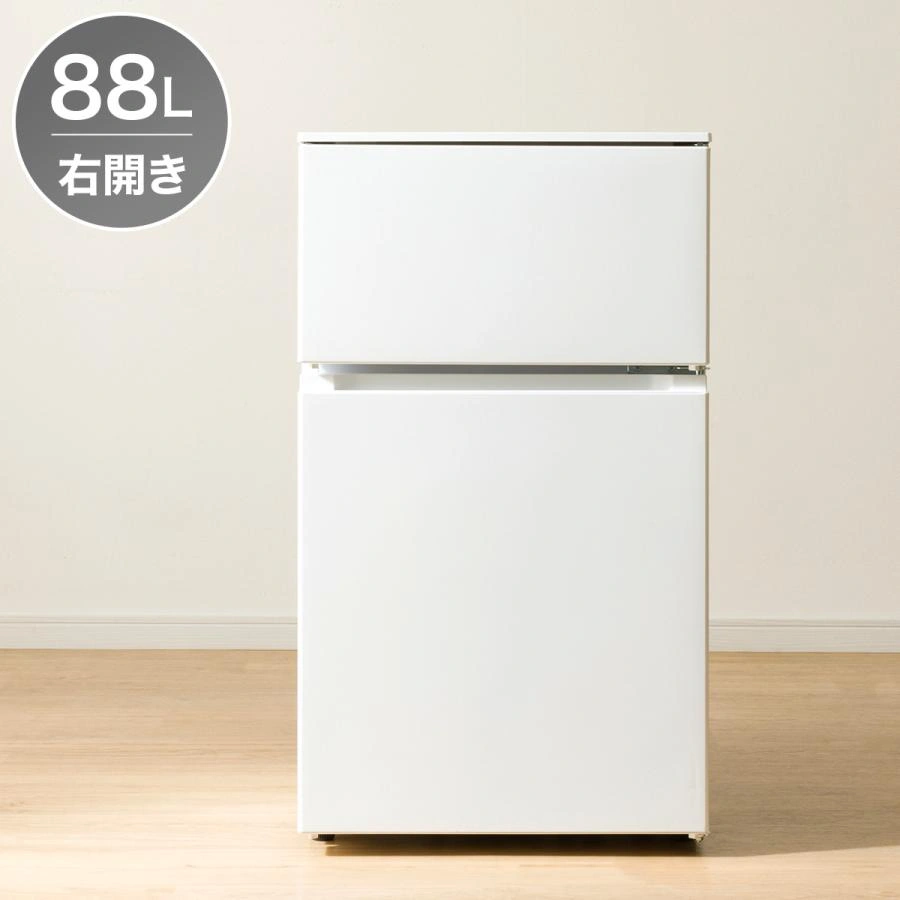
Current listing: GZ2G04 white, right-opening, no recycling collection, item2113400054776;88L(63L chilled/25L frozen),487×534×840mm. GZ2G01 in the supplied article is the launch-series name. Door direction cannot be reversed. Japanese100V model; reference price excludes delivery and extras.
GZ2G04 WH / 88L / right-opening / W487×D534×H840mm
JPY 24,900 · Overseas listing reference · 2026-10-20
NITORI · NITORI GZ2G04 WH 88L — right-opening
Why L2Mstore selected it
Our selection focus: capacity, placement and door clearance for refrigeration in a small space
Check the exact model, installation clearance and electrical requirements before choosing.