Lentil Pot
Is longevity becoming something only wealthy people can afford? That was the question the Himedi account brought to Reddit’s Biohackers community. Expensive screening, genetic tests, supplements and personalized treatments keep promising more years. The post acknowledged that sleep, exercise and healthy food need not cost a fortune. Access to healthcare and preventive testing can be a different matter.
There is a commercial background to keep in view. Himedi’s profile describes its business arranging health checkups in Korea for international clients. At the manuscript’s snapshot, the thread had roughly 15 upvotes, 16 comments and an upvote ratio close to one. Those figures describe a small conversation, not a population survey or clinical evidence.
How cheap are the basics?
One commenter gave a blunt answer. A whole-food, plant-based diet, sleep and plenty of cardio can cost very little. In their view, unnecessary screening, uninformative genetic tests and pointless supplements add little benefit.
Another put it in percentages. They reckoned that 98% was accessible to ordinary people through a Mediterranean-style diet, good sleep, regular movement, stress management and avoiding harmful habits. The remaining 2% of marginal optimization could be expensive. Those were the commenter’s estimates; the thread supplied no study establishing that split.
There is something worth keeping in that argument. Taking care of yourself does not require an expensive test receipt as proof. But the replies soon reached a question that good habits cannot settle by themselves. What happens when you need help?
Lentils and the scan
A participant argued that the basics may be cheap while the real gap lies in early detection and access to good care. They offered a sharp hypothetical. You could eat lentils and run with the hope of reaching 90, yet struggle if your insurer would not pay for a scan until cancer reached stage 4. It was an expression of concern, not evidence that every insurance policy works that way.
Someone else wanted universal healthcare that was free at the point of use. They also pointed out that people die from more than cancer, and stressed the role of diet and lifestyle in heart disease. Another reply took a longer view, referring to the Middle Ages and the nineteenth century. Its argument was that money has long shaped access to care, while parents and upbringing influence the resources people start with.
Everyday habits can matter, and access to healthcare can remain unequal. The discussion becomes more useful when there is room for both observations.
Food takes time, too
One commenter said that affordable food was only part of the story. Knowing what to look for and where to find it also takes knowledge. They described the prevalence of junk food in poor neighborhoods, while acknowledging exceptions. Another added the time spent preparing meals. An effort can be worthwhile and still carry a cost.
A reply pushed back. Put frozen, pre-chopped whole foods into an Instant Pot, they said, set it to one minute, then eat. That was their account of an easy routine, not a promise that an entire meal cooks in one minute or that everyone can organize their day the same way.
A public-health-minded participant listed social determinants of health. Environment, toxic exposures, genetics and chronic illness all featured, alongside parents’ education and income, a person’s own education and income, community and walkability. They also mentioned smoking, drinking, drug use, seat belts and helmets, as well as exercise and food. They argued that poverty is statistically associated with earlier death and placed particular weight on quitting smoking and drinking. The list captured their perspective; it could not assess an individual reader’s circumstances.
Another comment made the practical constraints harder to overlook. Rotating shifts can make eight hours of sleep difficult. Taking a morning off to see a doctor can mean lost wages. Money can make these supposedly simple things much easier. That commenter welcomed cheaper tests, but also wanted ordinary care without fear of the bill.
What spending can prove
There was some optimism about costs falling. One participant thought wealthy people would try new longevity interventions first and that cheaper options could follow. They mentioned vitamins and statins as relatively inexpensive examples. Yet spending several thousand on a full-body MRI, they added, shows the ability to try something; the price alone does not establish a benefit. The comment was not a reason to start medication or supplements on your own.
I would keep the disagreement in this conversation. There is good sense in making room for sleep, movement and food. There is also good reason to listen when someone brings up insurance, appointments and time away from work. “Keep life simple” can end that conversation too quickly. An expensive screening bill is no reliable measure of how seriously someone takes their health, either.
The lentil pot is a memorable image from a discussion. It does not decide whether a reader needs a test, a particular diet or a new kitchen appliance. Personal medical history, insurance arrangements and a clinician’s judgment still need attention. Other people’s comments can help us think; they cannot write our next test order.
The content of this article is only for reading, reflection and personal judgment. It is not an instruction manual. It is simply one part of the world as it exists.
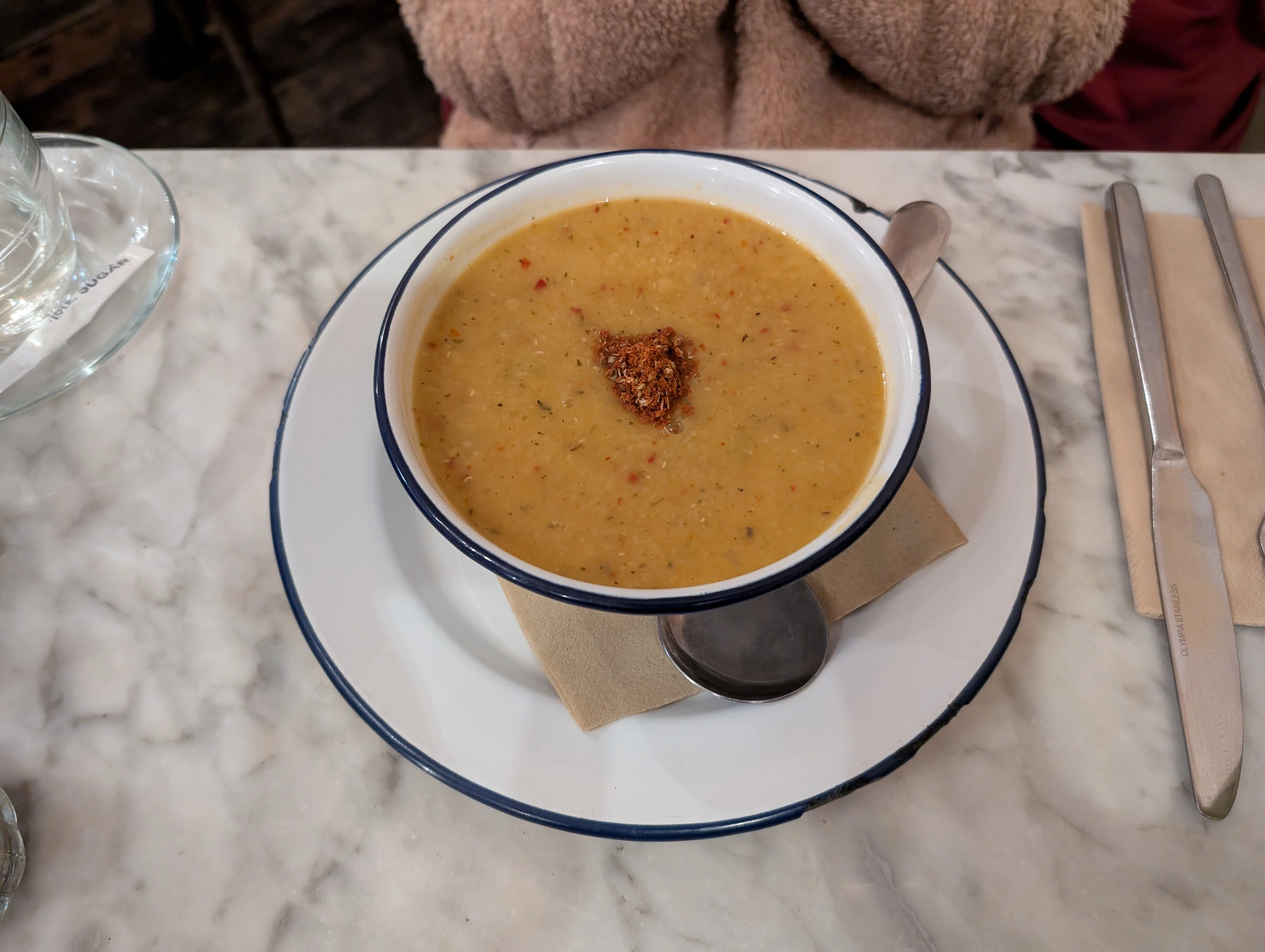
Lentil soup as a thematic illustration, not the poster’s meal. Photo by Andy Li / CC0 · https://commons.wikimedia.org/wiki/File:Homemade_Lentil_Soup_-_Lavash_2025-02-10.jpg · https://creativecommons.org/publicdomain/zero/1.0/ · resized / WebP
