Locked at Zero
The brace holds his knee at zero degrees, his leg straight. Three more weeks without bearing weight lie ahead. When he wrote those words, it had been twenty-two days since his surgery.
In a post asking a climbing forum for help, he described an upward and sideways dyno about a month earlier. He fell from roughly three to four metres and landed with one leg fully extended, taking much of the impact and rotation. He said he needed an ACL reconstruction, augmentation of the PCL and MCL, and repair of a radial tear in the lateral meniscus. His lateral collateral ligament and patellar ligament were also partially torn.
Those injuries are his own account. At the time of the post he said he had lost six kilograms, mostly muscle. The 29-year-old had previously spent twenty to twenty-five hours a week climbing and doing calisthenics. Now he was in bed nearly all day. It was his first serious injury.
He listed some things he could do before the accident: a pistol squat with forty kilograms added, a single-leg Nordic curl, and bouldering around 7B+ or V8. He also regularly carried heavy packs on approaches to alpine trad climbs. The numbers give a sense of his training and of the interruption he was facing.
The future was harder to describe. He said most of the medical professionals he had spoken to made it sound as though he might never regain his previous fitness and performance. He wanted to recover as much as possible, but had struggled to find people with similar injuries involving the PCL. At the end of the post he said he felt completely lost.
One commenter described returning to their previous sport-climbing level about nine to ten months after ACL and meniscus surgery. Long descents remained difficult, and they kept bouldering controlled and low. They also made clear that they had not injured their PCL or patellar ligament and could not judge whether the original poster would recover to his former level.
Another commenter had sustained an injury while practising parkour and spent six weeks with a brace locked at zero. They did not return to parkour and took up climbing instead. Someone else said it had taken a year after surgery to feel ready to boulder again, and that fear of falling and hurting the knee again could linger on the wall.
These accounts end in different places and offer no prediction for the person who asked. Some commenters encouraged him to find a doctor and physiotherapist who understood his sporting goals. Others suggested focusing on what he could do in the meantime. His own rehabilitation plan remains a matter for the medical team familiar with his injuries.
For now, he can name the angle of the brace and the three weeks without weight-bearing ahead. He posted because he wanted to hear from people who had been through something similar.
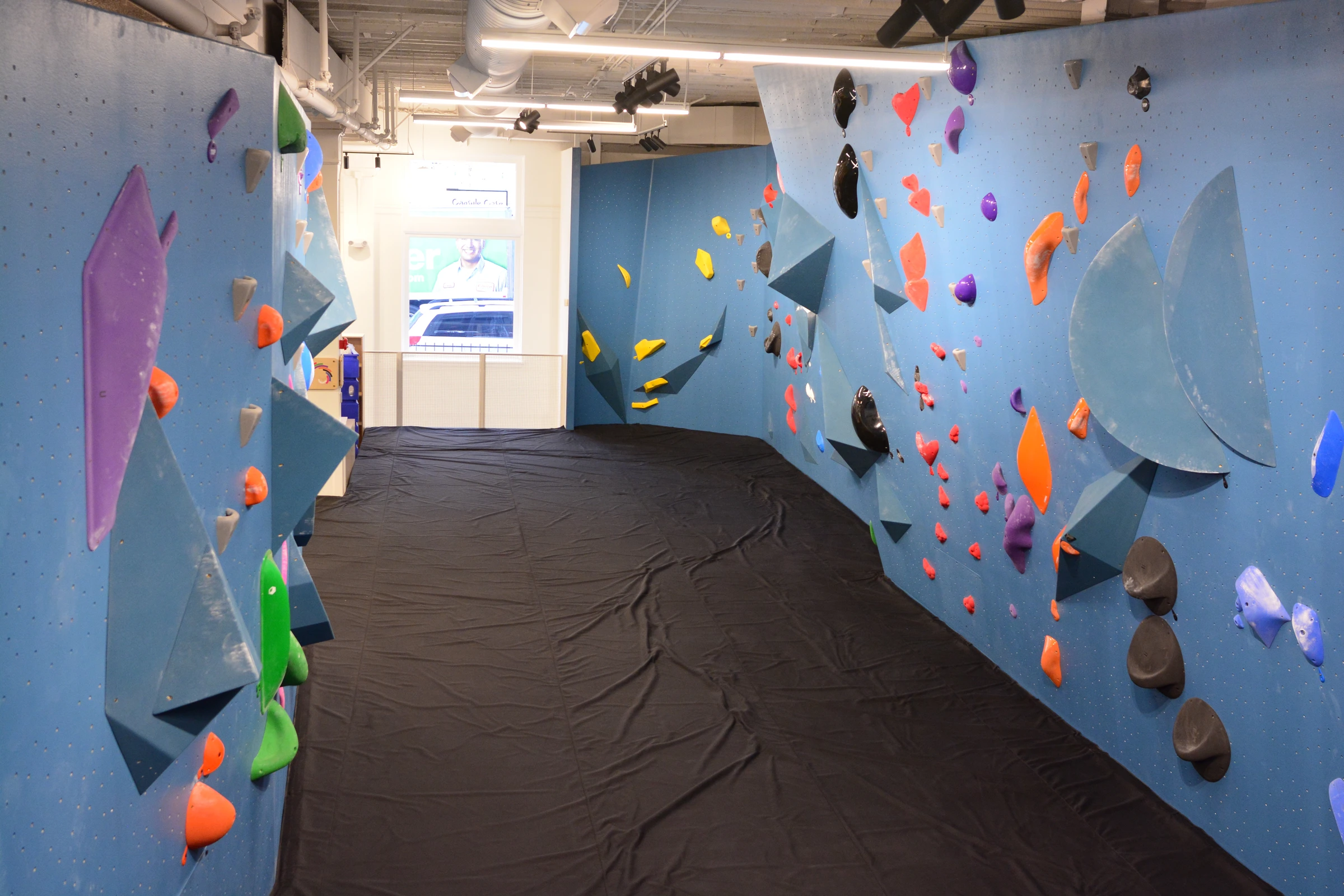
Illustrative climbing gym photograph, with no known connection to the poster or accident site. Joe Mabel / Wikimedia Commons · CC BY-SA 4.0 · https://commons.wikimedia.org/wiki/File:Bouldering_Project_(old_University_National_Bank)_09_-_ground_floor_climbing_walls.jpg · https://creativecommons.org/licenses/by-sa/4.0/ · resized and converted to WebP · https://www.reddit.com/r/ClimbHarder/comments/1xm7q2f/
