Longevity Research Beyond a Blood Test
If the last decade-plus of consumer longevity still drew the spectrum as a straight line—on the left, “a rising blood marker equals a longer life,” on the right, “only the prescription cabinet really works”—then when a blogger spread seventy-five peer-reviewed papers on longevity, rejuvenation, and preventive medicine into an open wiki, and around 25 April 2026 expanded the general-prevention corpus to seventy-five sources with layered recommendations, that line had already folded into a pair of shears: one blade is the tide of stacks, how NMN, NR, vitamin D, young plasma, and telomerase slogans became the default answer on the shelf; the other is the knife-edge of endpoints, still cutting “marker up” away from “mortality down” with RCTs and cohorts on all-cause death, cardiovascular events, and clinical endpoints. The image that runs through this discussion is not the next easier line—“add another layer of supplements”—or the next brighter claim—“biological age dropped again”—but the tide of stacks and the knife-edge of endpoints: on one side, the blogger’s checkable scenes—blood NAD+ rises while grip, skeletal-muscle index, and gait speed often fail to follow; on the other, the industry default almost in chorus—“stack = longevity” does not automatically cash out as endpoint benefit; the edge still asks whether you mistook a transient blood marker for a safe window on mortality.
From “NAD+ rises” to “endpoints do not follow”: how the default gets overturned
What the blogger did is plain: pull peer-reviewed literature out of the noise of a multi-billion supplement industry, and write “signal” back into layers—free tier, prescription tier, emerging tier, laboratory horizon—instead of inventing a longer shopping list. The title itself carries a harsh judgment: most of the stack is a nothing-burger; what actually moves mortality is often not in a capsule. The body need not become anxiety soup; it only needs to press the scenes concrete first.
NMN and NR are the most visible wave in the tide. Blood NAD+ can rise; clinical endpoints often do not follow. A 2025 large-sample NR RCT in long COVID was at best mixed on cognition and recovery metrics; later systematic reviews and meta-analyses (including public trails such as PMC11365583 and PMC12022230) likewise show no significant improvement in grip, skeletal-muscle index, or gait speed. Industry default likes to write “cofactor up” as “person younger”; the papers overturn that default—markers can flood, the edge still asks whether endpoints ebb with them.
Supplementing vitamin D in non-deficient adults is equally awkward. VITAL 2019 (NEJM, n=25,871, 5.3 years of follow-up) freezes the scene: cancer HR 0.96, CVD HR 0.97, all-cause death HR 0.99—approximately null. Test first, then supplement; supplement only confirmed deficiency. That sentence pulls the running image from “universal pill on the shelf” back to “whether the half-inch edge sits on evidence of deficiency”: the tide can raise the volume of “everyone should take D,” yet it cannot cut open whether you have already tested, rather than merely twisting the bottle open.
“Young plasma” without a clear active component is harsher. A 2025 RCT (Horvath co-author) showed plasma removal without IVIG as negative, with some clocks even accelerating; what worked was a TPE+IVIG protocol (biological age about −2.6 years), hinting that the activity more likely sits in IVIG than in simple plasmapheresis. The telomerase-drug page also writes a half-inch edge: a 2022 PNAS paper claiming +41% lifespan was retracted in August 2025. Most longevity stacks—resveratrol, anti-aging peptides, exotic herbal mixes—remain nearly blank at endpoint-grade RCTs. The default therefore shows its seam: it thought “marker up” could cash out losslessly as “mortality down”; the layers rewrite it with the same checkable clash—the tide of stacks can raise the cart, the edge still asks whether endpoints keep pace, rather than hiding only in the next, more expensive NAD+ precursor.
Five-point-oh-four and grip: how the free tier cuts into mortality
Quiet scenes almost embarrassingly stick to the free tier itself. Mandsager 2018 (JAMA Network Open, n=122,007) writes cardiorespiratory fitness into all-cause death: low VO2max versus elite, HR 5.04—in the same cohort, larger than smoking, diabetes, or prior CAD; no clear ceiling of benefit either. A Norwegian 4×4 protocol can lift VO2max about 13% in roughly eight weeks (Helgerud 2007, MSSE). The question lands cleanly: the tide writes itself on capsule ads; the edge writes itself on whether you treat peak oxygen uptake as a harder lever than the next bottle.
Grip and resistance are equally sharp. PURE (n=139,691, seventeen countries) shows grip predicting cardiovascular death more strongly than systolic pressure. Resistance alone about −21% mortality risk; combined with aerobic about −40% (Saeidifard 2019 meta-analysis). Sleep 7–9 hours is U-shaped: Cappuccio 2010 meta-analysis (about 1.4 million adults) has short-sleep RR 1.12, long-sleep RR 1.30. Waist, not BMI: Pischon 2008 (NEJM, EPIC, n=359,387) finds waist and waist-hip ratio independently predicting death at every BMI stratum. Not smoking; ethanol about ≤100 g per week (about ≤7 drinks/week)—Jha 2013 (NEJM) writes smoking as more than ten years of life lost; Wood 2018 (Lancet, n=599,912 drinkers) pins lowest mortality risk near 100 g ethanol/week; “moderate drinking protects” often vanishes after correcting for sick quitters.
For people who already treat “supplement stack = anti-aging” as a holy grail, HR 5.04 and grip are quenching; for people who already treat a “biological-age app” as discipline, waist independent of BMI is more quenching. The running image therefore drops from “tide of stacks” to “the knife still in the sheath must still tell endpoint before it edges out half an inch”: the question is how many points blood NAD+ rose, or whether VO2max, grip, sleep, and waist still read the tide. The free tier writes itself on cohorts and meta-analyses; the edge writes itself on whether you still mistook “marker up” for an “endpoint safe window.”
VITAL and retracted telomerase: the half-inch edge inside the supplement tide
The prescription side is not blank. CTT 2012 (Lancet IPD, 27 RCTs) writes statin primary prevention: each 1 mmol/L drop in LDL-C, about −21% vascular events per year, including low-risk adults—systematic under-prescription is itself an edge. SPRINT 2015 (NEJM, n=9,361 non-diabetic hypertension) presses blood-pressure targets toward <120: intensive control, all-cause death −27%, stopped early for benefit. Measure apoB; do not only watch LDL-C: trails such as Sniderman 2011 show apoB about 12% better on relative-risk prediction than LDL-C; ESC/EAS already names it a preferred lipid marker. Rapamycin stays in the “emerging” tier: PEARL 2025 shows one-year safety and healthspan-marker improvement—among emerging drugs, one of the few with human RCTs; the text need not write “prescribe for everyone,” only admit: the prescription tier has endpoints; most of the supplement tide does not.
The laboratory horizon can pass in one sentence: anti-IL-11 antibodies, trametinib+rapamycin, AAV-Klotho, CAR-T senolytics, partial reprogramming—horizon beyond the tide, not yet for sale, and not to be pretended already consumable. Comment-section common sense is plain: get the base right first, then talk drugs and supplements; the layering itself is the clash—industry default “stack = longevity,” data overturn “endpoints do not follow.” The dial itself speaks—NAD+ lights up while all-cause HR does not light with it; the tide writes itself on a seventy-five-source wiki and shelf slogans; the edge writes itself in the cracks of HR 5.04, VITAL’s near-null, grip stronger than systolic pressure, waist independent of BMI, and a retracted +41%. The body need not adjudicate every medicine cabinet; it only needs to admit: the default thought “marker up” and “add another layer” could cover endpoint credentials; the layers rewrite that with checkable RCTs and cohorts—the tide of stacks often dies on “biological age dropped again,” while the knife-edge of endpoints often pretends the capsule was already enough.
Close: rewrite “independence” as “holding both blades—tide of stacks and knife-edge of endpoints”
If anti-aging culture often reads independence as “one person fills the cart before talking training” or “one person believes marker up equals living longer,” this discussion sits closer to another independence—holding the tide of stacks and the knife-edge of endpoints at once, refusing the false binary. The blogger’s compilation has value precisely because it lays checkable scenes on the table (seventy-five-source layers, NMN/NR endpoints not following, VITAL near-null, young-plasma activity more likely in IVIG, telomerase retraction, VO2max HR 5.04, grip and resistance, sleep U-shape, waist independent of BMI, statins and SPRINT and apoB, rapamycin only as emerging); the discussion’s value is that it does not push the topic only toward “quit all supplements” or “the tide will always recede,” but says the spirit of the rule back: tell endpoint from marker first, then tell “stack” from “free-tier half-inch,” and with HR 5.04, VITAL, grip, and waist still polish that blade inside the flood of “NAD+ rose / biological age dropped”—the difficulty of longevity often hides in whether you can read both blades, tide of stacks and knife-edge of endpoints, rather than only in the next easier “add another layer” or the next brighter “marker rose again.”
Executable prompts are plain: test deficiency before vitamin D, rather than chase shelf slogans first. Treat VO2max, grip, sleep 7–9 hours, and waist as the first layer, rather than automatically cashing out “supplements already enough.” Treat the prescription tier (statins, blood-pressure targets, apoB) as checkable contrast, rather than default outsourcing to the next, more expensive precursor. Watch all-cause death and clinical endpoints, rather than only transient blood markers. Write “independence” as “holding both blades—tide of stacks and knife-edge of endpoints,” rather than “always outsource to the next easier add-another-layer” or “always outsource to the next brighter biological-age drop.” The horizon beyond the tide can be glanced at; do not pretend you can already place the order. Whoever holds tide and edge at least knows which lever they are pulling: endpoint, or marker.
The content of this article is only for viewing, reflection and independent judgment. It is not an instruction manual. It is simply a part of what exists in the world.
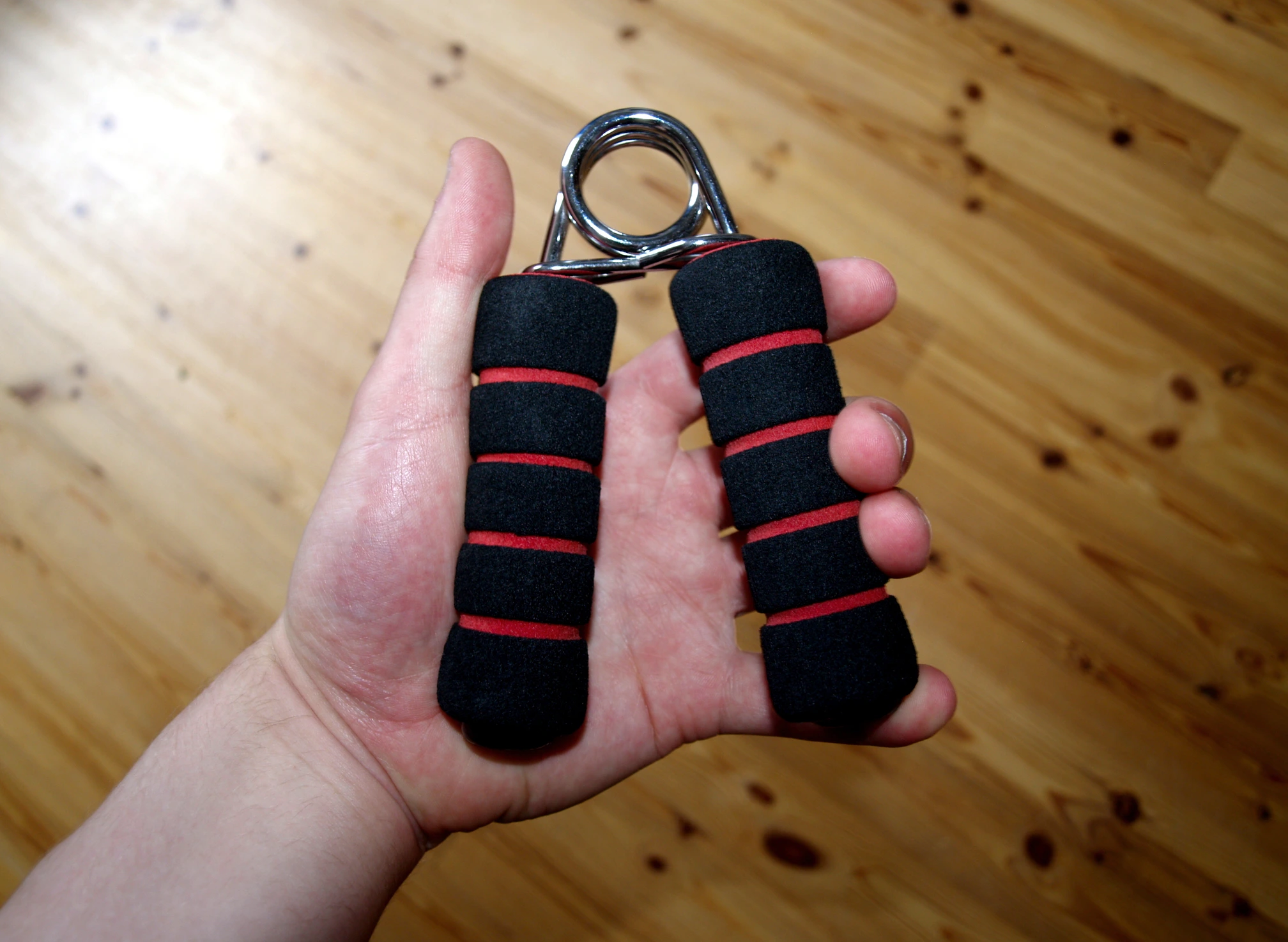
A hand gripper, photograph by Santeri Viinamäki · CC BY-SA 4.0 · https://creativecommons.org/licenses/by-sa/4.0/
https://commons.wikimedia.org/wiki/File:Hand_gripper.jpg

Full frame retained; resized and converted to WebP.