The First Hurdle of a Marathon Is Getting a Bib
If the past decade-plus of mass marathons was still drawn as a straight line—on the left, “race day is far off; a local major always has room,” on the right, “only Boston-class gated races are truly hard to enter”—then after Brian Rock laid out the sellout calendars of roughly the fifty largest U.S. marathons on 28 May 2026, that line had already folded into a pair of scissors: one blade is the tide of sellouts turning nineteen of twenty-three spring races into “full,” the other is the knife-edge of bibs still cutting registration calendars away from training calendars inside twelve-hour sellouts, a 5 January cutoff, and a rebound of about three thousand reopened spots. The image that runs through this piece is not a lazier “sign up in the fall” or a brighter “you can still snag one,” but the tide of sellouts and the knife-edge of bibs: on one side, the verifiable scene the blogger forwarded—among the fifty largest races by 2025 size, of the twenty-three held January–June 2026, nineteen had sold out; on the other, the industry default almost in chorus—“race day is far off” does not automatically convert into a safe window; the edge remains whether you mistook the opening of your training block for a registration safety window.
From “Still Open” to “Nineteen of Twenty-Three”: How the Default Was Overturned
What the blogger did was plain: put a long piece tracking sellout dates for roughly the fifty largest U.S. marathons on the table—the title itself carries the sharp judgment “faster and more often,” yet the body need not become anxiety porridge; first press the scenes concrete. Brian Rock’s Spring 2026 Update spreads the same verifiable clash: of the fifty largest races by 2025 size, twenty-three fall in January–June 2026; nineteen have sold out; only four have not—Rock ’n’ Roll San Diego, Austin, Denver Colfax, REVEL Mt. Charleston. The three that are “effectively sold out / nearly impossible” year after year need no invented drama: Boston’s time gate, Big Sur’s lottery, Disney selling out in hours—none of them was ever covered by “race day is far off.”
The narrative is familiar in running circles and still sharp enough. Industry default likes to write “a local major always has room” as common sense, or “only gated races are truly hard” as comfort; the post and the long piece overturn the default not by inventing a third slogan, but by pressing scenes concrete—the same verifiable numbers: nineteen of twenty-three full; six newly sold out in 2026 after not selling out in 2025—Jersey City (sold out 2/12 → race 4/19), Flying Pig (4/30 → 5/3), Rock ’n’ Roll Nashville (4/21 → 4/25), Mesa (2/13 → 2/14), Oklahoma City (3/25 → 4/26), OC (3/13 → 5/3). Finisher counts often rose: Flying Pig 4,685 → 5,251; Nashville 2,706 → 3,173; OC 3,056 → 3,545. The default therefore shows its seam—it assumed “still open” could convert losslessly into “spots a week before the race”; the calendar rewrites it with the same clash: the sellout tide can raise the threshold feel of local races; the edge remains whether the registration calendar sits earlier than the training calendar, not only in the self-soothing of “months until race day.”
Twelve Hours and the Fifth of January: How the Tide Cuts into Fall and Spring
The key scenes sit almost awkwardly on the sellout dates themselves. Los Angeles: sold out 5 Jan 2026 → race 8 Mar, versus 4 Feb → 15 Mar in 2025—a full month earlier. Houston: sold out 1 Oct 2025 → race 11 Jan 2026, versus 15 Nov the prior year; finishers also rose from 7,553 to 8,852. Eugene: sold out 14 Jan → 26 Apr, versus roughly March the year before—about two months earlier, finishers 3,764 → 4,518. Mountains 2 Beach: 26 Feb; Miami: sold out about ten days after opening on 11 Aug 2025. Sharpest of all is Grandma’s: sold out in about twelve hours; organizers shifted half-marathon bibs to the full marathon and still could not slow the rush. That sentence yanks the through-image from “spring races can still wait” back to “is the half-inch edge on the register button”: the tide can lift finisher counts and local heat, yet it cannot cut open whether you already held a bib before the training block opened.
For people who treat “race day is far off” as a holy grail, 5 January and twelve hours are thirst-quenching; for people who treat fall majors as “register after training starts,” the early fall/winter sellouts are more so. The through-image therefore drops from “sellout tide” to “the knife still in the sheath must tell registration calendar from training calendar before another half-inch”: the question is not how many months until race day, but whether you still read the tide in the week after registration opens. Detroit (October race) sold out 7 Jan 2026, about a week after opening; CIM sold out 5 Mar, versus 8 May the prior year; St. George 29 Apr; Wineglass 18 May, versus 25 Jun—some fall races now sell out before many people even start their fall training block. The tide is written on sellout dates; the edge is written on whether you still mistake “training-block start” for a “registration safety window.”
Three Thousand Reopened and Rising Scale: Half an Inch of Bib Edge
Philly’s scene almost looks like a tidal rebound: after selling out on 28 Apr, about three thousand spots reopened with a new title sponsor—registration opened again, yet no one can guarantee how long the rebound lasts. That half-inch asks cleanly. Industry default shows its seam again: it assumed “sell out then reopen” could convert losslessly into a second safety window; the calendar spreads the priority—reopening is tidal rebound, not a default reset. The four that sold out at similar times but grew in scale are equally sharp: Pittsburgh finishers 3,781 → 5,013; Atlanta 1,947 → 3,070; Shamrock 1,957 → 2,421; Cowtown 1,757 → 2,134. Sellout dates need not leap much earlier; the edge is already written on whether, without more bibs next year, the cut moves into March or earlier.
For people free to race-hop and keep flexible calendars, three thousand reopened spots are leverage; for people who treat “a local major always has room” as discipline, the same tide reads like an edge pressed on the register button. The dial itself speaks—finisher counts glow, while the registration safety window is buried in the menu; the tide is written on nineteen of twenty-three and six new sellouts; the edge is written in the cracks of twelve hours, 5 January, about a week after opening, and “training-block start ≠ registration safety window.” The body need not adjudicate everyone’s race calendar; it only needs to admit: the default assumed “race day is far off” and “reopening always lets you in again” could cover bib eligibility; the long piece rewrites it with verifiable sellout calendars—the sellout tide often dies on “sign up in the fall,” while the bib edge often pretends three thousand reopened spots were already enough.
Closing: Rewriting “Independence” as Holding Both Blades of Sellout Tide and Bib Edge
If running culture often understands independence as “fill the training block first, then talk registration” or “believe a local major always has room,” this discussion is closer to another independence—holding both the sellout tide and the bib edge at once, refusing the false binary. The blogger’s post has value precisely because it spreads verifiable scenes (Brian Rock’s tracking of roughly fifty sellout dates, nineteen of twenty-three spring races full, six new sellouts and six significantly earlier ones, early fall/winter examples, Philly’s about three thousand reopened) on the table; the discussion’s value is in not reducing the topic to “miss it, switch races” or “the tide will recede,” but saying the spirit of the rule back: first tell registration calendar from training calendar, then tell “still open” from “half an inch of bib edge,” and with twelve hours, 5 January, about a week after opening, and the rebound of reopening, still polish that blade inside the rising tide of “race day is far off / locals always have room”—the difficulty of the marathon often hides in whether you yourself can read both blades of sellout tide and bib edge, not only in a lazier “sign up in the fall” or a brighter “reopening still lets you snag one.”
The actionable tip is plain: read the sellout calendar, instead of first chasing the self-soothing of “months until race day.” Treat the training-block start as a tidal condition, not an automatic voucher for a registration safety window. Treat reopened spots as a verifiable rebound contrast, not a default reset. Watch sellout dates a week after opening and months before race day, not only rising finisher counts. Write “independence” as “holding both blades of sellout tide and bib edge yourself,” not as “forever outsourcing to a lazier fall signup” or “forever outsourcing to a brighter ‘locals always have room.’” Limits remain: the Reddit comment section was not pulled line by line; individual finisher counts follow the long piece’s tables—the half-inch edge is admitting these, not turning sellouts into a personal fate verdict. People who hold tide and edge at least know which lever they are pulling: the registration calendar, or the training calendar.
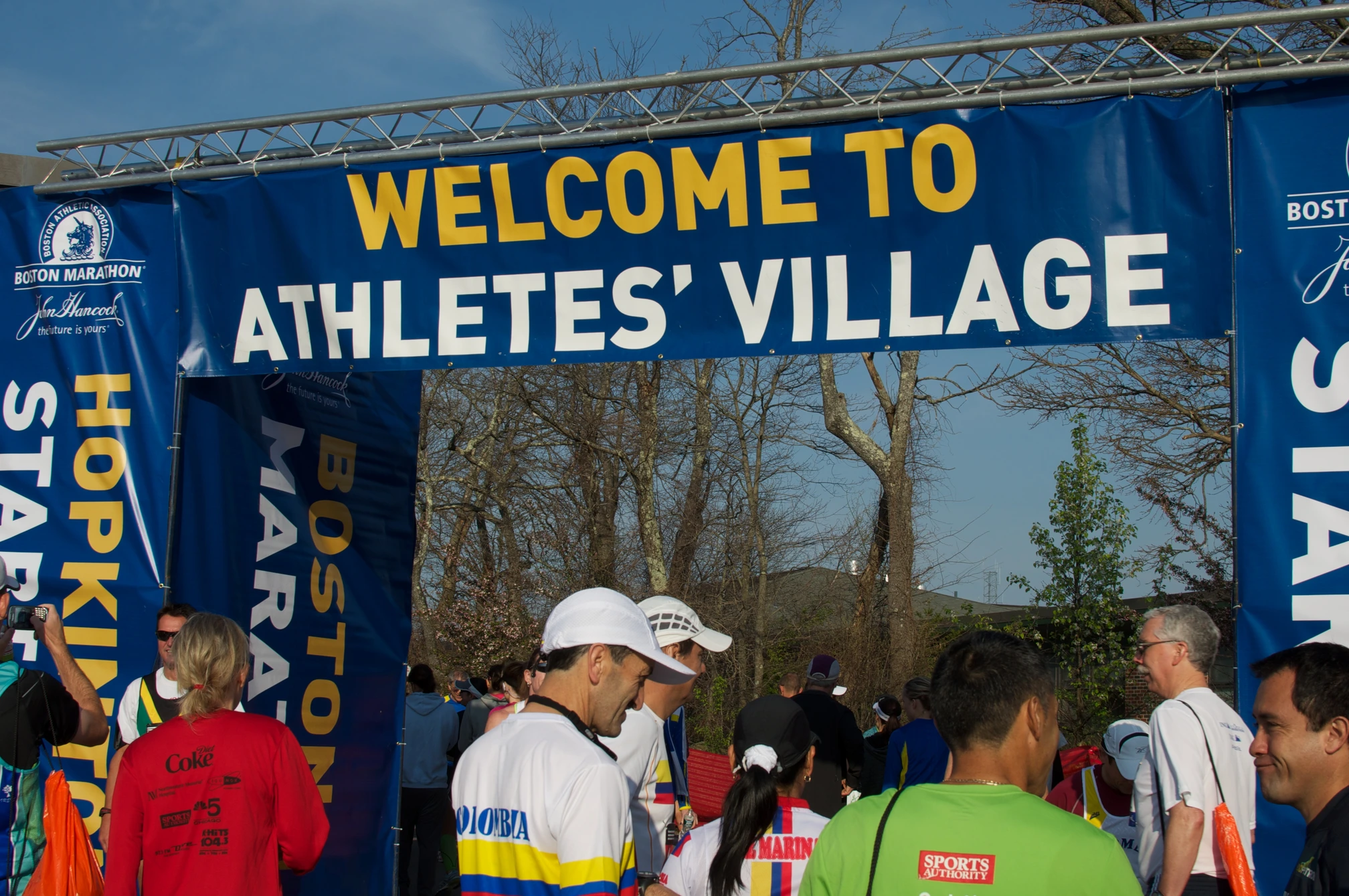
Athletes entering the village before the 2012 Boston Marathon, Ryan Hutton / BU Interactive News · CC BY 2.0 · https://creativecommons.org/licenses/by/2.0/
https://commons.wikimedia.org/wiki/File:Marathon_1_(6938061892).jpg

Full frame retained; resized and converted to WebP.