Tides of Mileage and the Knife-Edge of Threshold
If, for more than a decade, popular endurance training still drew the spectrum as a straight line—more kilometers on the left, intervals on the right—advanced runners had already folded that line into a pair of scissors: one blade chronic load and weekly volume, the other lactate threshold, steady state, and neuromuscular recruitment. The image that runs through this discussion is not a finish-line watch, but the tide on either side of the threshold: on one side a slow rise from about 60 km toward 100 km of weekly mileage; on the other, structured intensity deliberately shelved—and a comment section almost unanimous in warning that when the tide rises, the knife should not disappear entirely into its sheath.
From “Stack Volume, Then Add Intensity” to “Volume Can Rise While Intensity Is Maintained”: How the Default Logic Gets Pried Open
the blogger states the case clearly: currently about 60 km per week; a 3:28 marathon last autumn and a 1:29 half last year. Over the next three to four months, the plan is to build gradually toward roughly 100 km/week and keep everything easy—no structured threshold or VO2 sessions for now, only strides twice a week, and occasionally letting a long run progress a bit, but no proper workouts.
That narrative sits flush against the default logic of many plans and coach talk-tracks: what limits you in the marathon is aerobic depth and durability, not speed; so spend a solid block getting comfortable at higher volume before inviting intensity back. The closing question is honest: has anyone done something similar at this level? Any real downside to leaving out LT work that long, as long as mileage is moving up?
The comments do not follow the cozy “pure aerobic first” story. one commenter (~36 upvotes) rewrites “volume or intensity” as “is chronic load stable?”: people go all-or-nothing about the two; the spirit of the rule is to stabilize the chronic load you have already adapted to—you can increase volume while maintaining intensity you already adapted to, rather than stacking biggest-peak threshold work on top of rising mileage. In other words, default logic misreads “add volume” as “intensity must first go to zero.” The crack this thread opens is that adding volume and maintaining intensity can share a table; the real danger is “peak threshold × rising mileage.”
This is not a semantic quibble. For someone who has already run 3:28 and 1:29, “intensity” is often not a foreign stimulus from scratch, but a language the body already knows; deleting that language for three months and relearning it later usually costs more than continuing to speak it at a lower dose. The desire to “get comfortable at higher volume” is sound—what the thread refuses is rewriting “comfortable” as “zeroed out.”
The Crack Between 1:29 and 3:28: Why a Durability Story Still Needs the Knife of High-End Aerobic Work
The numbers in the post speak. The gap between a 1:29 half and a 3:28 full is often read, in advanced circles, as: speed near lactate threshold may not be the weak link; carrying half-marathon capability across the full distance is. Ivan Gechev’s take is close: that gap points more to durability than to LT fitness itself; pure volume plus strides is well-precedented—yet also consider adding some steady/moderate work alongside the easy volume, rather than compressing the spectrum to a single color.
Raphael Serrano (~14) sharpens the blade: high-volume easy alone is often not enough for marathon durability—the race happens above LT1; you need high-end aerobic work; while mileage rises, keep a little steady/threshold—e.g. one mild workout + strides/hills + optional long-run progression; do not think in binary. another commenter (~6) offers a harder rhythm: if you are seriously upping volume, threshold at least every 10–14 days; in that view, 70–80 km weeks with threshold and strides often beat pure 100 km weeks for a faster marathon.
Default logic fails again: it equates “durability” with “more easy kilometers.” The thread rewrites it with race physiology—durability is the ability to hold on at a higher metabolic cost, and that cut is exactly what delayed threshold work trains.
Press the scene more concrete: as weekly volume climbs from 60 toward 100, the calendar fills with more easy kilometers, more recovery demand, and fewer windows for hard sessions. The compromise the comments offer admits the windows narrow—so swap “structured VO2 / big threshold” for “mild steady + strides + occasional progression,” not for blank space. Blank looks cleanest, and most easily lets pace feel and recruitment rust over three months.
The Cost of “Pure Easy for Months”: Recruitment, Pace, and Near-Threshold Length on a Lydiard Base
another commenter’s warning leans neuromuscular: pure easy for months makes you slower; you lose muscle recruitment at marathon pace and above—so periodize the jumps rather than leave intensity hanging for long stretches. another commenter offers a path that stays near the knife without hard LT: if you avoid tough lactate-threshold sessions, do longer, slower near-threshold / aerobic-threshold / steady work—e.g. ~40 minutes at 6:40 if LT is about 6:15/mile; Lydiard-style base often sits near this—and keep strides 6–8×15s twice a week for neuromuscular bounce.
Together these comments do not deny the blogger’s intuition (aerobic depth and durability may well have limited the marathon). They refuse to define “building the base” as “sheathing the threshold knife completely.” The through-line image thus moves from “rising tide” to “the knife must still flash half an inch from the sheath”: strides, near-threshold steady, mild threshold, controlled long-run progression—all half-inches, enough so recruitment and high-end aerobic work do not simply vanish three months later.
Closing: Redefining “Independence” as Holding Both Blades of the Scissors
If popular training culture often treats independence as “grinding alone to add miles” or “going hard alone on intervals,” this discussion points to another kind—holding both the tide of weekly volume and the knife-edge of threshold, and refusing the false binary. the blogger’s question matters because the numbers (60→100, 3:28, 1:29) are on the table; the comments matter because they refuse the pure-aerobic myth and return the spirit of the rule: stabilize chronic load, maintain adapted intensity, and keep mild work and strides polishing the edge while the tide rises.
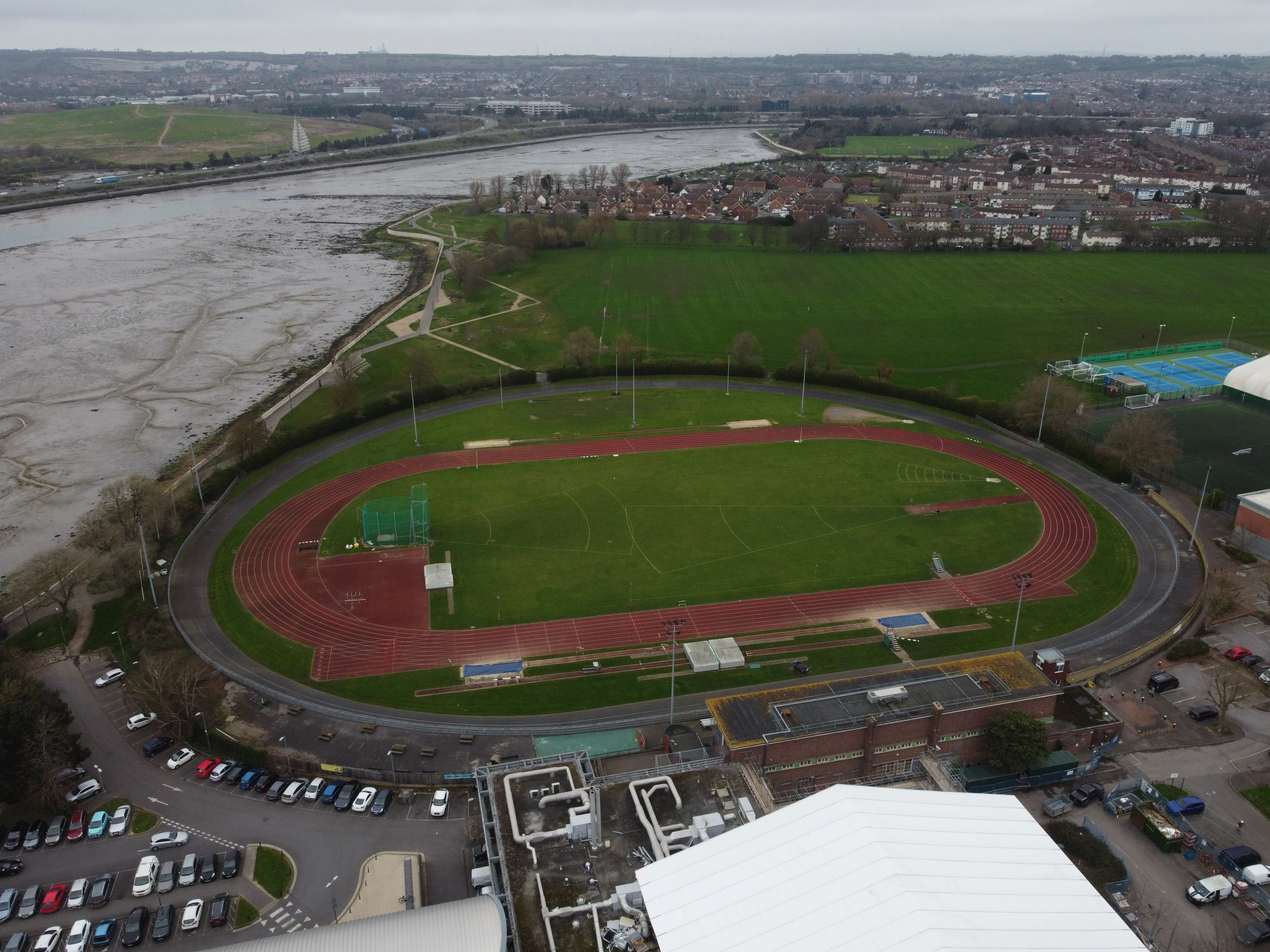
Mountbatten Centre athletics track, photograph by Tim Sheerman-Chase · CC BY 2.0 · https://creativecommons.org/licenses/by/2.0/
https://commons.wikimedia.org/wiki/File:Mountbatten_Centre_Athletics_Track.jpg

Full frame retained; resized and converted to WebP.