At Three in the Morning, Questions in a Glucose Trace
If, over the past decade or more, the popular biohacking spectrum was still drawn as a straight line—on the left “wear one more sensor,” on the right “add one more bite of protein before bed”—then once continuous glucose monitors entered non-diabetic households, that line folded into a pair of scissors: one blade is the overnight sugar curve slowly sinking and the adrenergic alarm that rings on time at three; the other is whether hepatic glucose output, counter-regulation, and metabolic flexibility can still carry a normal overnight fast. The image that runs through this discussion is not the next supplement checklist, but the tide on either side of three o’clock: on one side, nocturnal glucose drawn as a smooth CGM curve; on the other, a comment section almost in unison warning that when the curve drops to about 60 with anxiety and hunger, the knife-edge should not be “just eat one more bite before sleep.”
From “the bedtime snack as ballast” to “the overnight fast as the test itself”: how the thread pries open the industry default
The poster is clear: no matter what is eaten by day or before bed, blood sugar creeps downward all night until about 3 a.m., when it reaches roughly 60, then wakes them—anxious, hungry—often unable to stay asleep more than four or five hours. The question is honest, and it sits flush against a default logic in much quantified-self talk: if you wake at night, refuel; if the curve is unsteady, add protein, fat, complex carbs; treat sleep-maintenance insomnia first as “not enough overnight fuel.”
That narrative is familiar in biohacking circles. Once a CGM is on, night stops being darkness and becomes a dashboard; when a trough appears, the most intuitive move is to pour something else into the tank—eggs, nuts, casein, even a spoon of honey. The post itself almost invites that answer: “Why can’t anything I eat stop the tide at three?”
The comments do not follow the comfortable story of “optimize one more midnight snack.” One commenter (about 21 upvotes) rewrites the question from “what to eat at night” into “is your counter-regulation still on duty”: if a finger-stick also confirms about 60—and it is not a compression low from lying on the sensor—then waking at three because glucose has drifted, with anxiety, is not a “try more eggs before bed” problem. It is a sign that glucose control and counter-regulation are badly dysregulated. A bedtime snack can paper over the symptom; the deeper crack is that the body apparently cannot hold stable fasting glucose through the night. In a metabolically healthy state, a person should sleep through a normal overnight fast without an adrenergic hunger-and-anxiety wake-up.
This is not a pedantic word game. For someone who already has a verifiable overnight sugar curve, “add a snack” is not a foreign trick—it is the circle’s default emergency language; treating that language as the only solution usually costs more than first asking whether hepatic glucose and insulin still keep time. The poster’s wish to “sleep past three” is entirely valid—what the comments refuse is rewriting “sleeping past” as “infinite refueling by night snack.”
About 60 and three on the clock: why the night tide still needs the knife-edge of hepatic output
The numbers in the post speak for themselves. A slow all-night decline, about 60, anxious hunger, waking after four or five hours—in biohacking circles these figures are often read as two opposing stories: one says “not enough overnight fuel, top it up”; the other says “the fuel story masks failed counter-regulation.” The highly upvoted comment stands with the latter: recurrent nocturnal hypoglycemia-style awakenings often point to unstable insulin dynamics—too much insulin relative to available glucose, mistimed hepatic glucose output, impaired metabolic flexibility, or some form of late reactive hypoglycemia that overlaps with insulin-resistant / prediabetic physiology—not a harmless personal sleep quirk.
Another commenter lays out a checklist: medications and supplements, evening exercise, alcohol, known hormonal issues, liver disease or other metabolic problems, and whether measurement is CGM, finger-stick, or subjective feel. The questions look fussy, yet they drag the “tide at three” out of a single-supplement narrative into a multi-cause scene: alcohol, muscles still taking up glucose after evening resistance work, and sensor compression lows can all impersonate the same “about 60” on one curve.
Here the industry default shows its seam again: it assumes “stable overnight glucose” equals “one more feed before bed”; the comments rewrite it with the most basic metabolic test—the overnight fast. True stability is the liver dripping glucose into the blood on rhythm, and counter-regulation lifting the line when needed; that knife-edge is exactly the hepatic and fasting tolerance long covered by the bedtime-snack myth.
Press the scene more concrete: if the same adrenergic wake-up hits every night at three, the calendar fills not only with fragmented sleep but with a growing dependence on “eating every few hours.” The highly upvoted comment’s direction is to admit that food can temporarily cover the symptom—and therefore to change the prescription from “always snack” to “gradually rebuild fasting tolerance”: an earlier eating window, lower glycemic-load meals, walking and resistance training, progressively longer overnight fasts, so insulin comes down and hepatic regulation returns to tempo. Intermittent fasting / time-restricted eating is often observed to improve fasting glucose, fasting insulin, HOMA-IR, HbA1c and related markers in insulin-resistant populations—but the premise is not treating symptomatic lows near 60 as a badge to tough out alone; that is a serious metabolic signal.
“A spoon of honey” and “false lows”: patches, compression, and half an inch of blade
Another commenter offers a very concrete scene: what finally worked was a tablespoon of honey just before bed—fructose preferentially stored in the liver, then slowly converted to glucose dripping into the blood; other bedtime carbs were tried, only honey worked. The narrative explains night waking as the liver lacking enough glucose to meet cortisol fluctuations in sleep, so the body stays alert. This is the patch logic with the clearest physiological picture: not the abstract “eat more,” but naming the liver as the reservoir.
It need not cancel the highly upvoted comment; together they form the tension of the through-image: honey can be half an inch of blade out of the sheath—while confirming finger-stick values, ruling out compression lows, and rebuilding fasting tolerance, a small hepatic substrate can hold the night’s alarm down; or it can be the knife fully sheathed—depending on a spoon of sweet every night without asking why a normal overnight fast fails. A parallel reminder comes from the sensor itself: pressure on the sensor can impede interstitial flow and the curve can “fake a crash”; lying on it awake for fifteen to thirty minutes can drop the number, then rolling over can bounce it back—so if about 60 has never been finger-stick verified, the tide may be written on the skin, not in the metabolism.
Taken together, these comments do not deny the poster’s intuition (the night sugar line and the awakening may share a mechanism); they refuse to define “biohacking” as “forever covering the dashboard with the next spoonful of patch.” The through-image therefore moves from “tide at three” to “the knife in the sheath must still tell truth from falsehood before it comes out half an inch”: finger-stick checks, questions about alcohol and evening training, questions about drugs and liver, small hepatic substrates, and turning the eating window and glycemic load back—each is half an inch, yet enough to make the overnight fast a trainable capacity again, not something forever outsourced to the fridge.
Closing: rewriting “independence” as holding both blades—the curve and the fast
If popular biohacking culture often reads independence as “buying every sensor alone” or “stacking the full bedtime stack alone,” this discussion is closer to another independence—holding at once the tide of the CGM curve and the knife-edge of the overnight fast, refusing the false binary. The poster’s question matters because the verifiable scene is laid on the table (all-night decline, about 60, anxious hunger at three, waking after four or five hours); the comments matter because they do not push the poster into the “eternal snack myth,” but speak the spirit of the rule back: first tell truth from artifact (finger-stick, not compression low), then tell layers apart (symptom patch versus metabolic rebuild), and with an earlier window, lower glycemic load, and progressive fasting, keep the hepatic knife bright even while the alarm tide rises.
The actionable tip is plain: if you also see a similar night tide on a CGM, first verify lows with a finger-stick while awake and rule out side-sleep compression; log alcohol, evening training, medications, and what was actually eaten before bed, rather than only changing “one more bite”; short-term, a small, verifiable hepatic substrate may hold the night’s alarm, but the mid-term goal should be written as “rebuild the capacity to sleep through a normal overnight fast”—rewrite “stable curve” as “counter-regulation back on duty,” not “infinite night refueling.” Recurrent symptomatic hypoglycemia warrants clinical evaluation, not treating about 60 as an endlessly self-experimentable tidal landscape.
The content of this article is only for viewing, reflection and independent judgment. It is not an instruction manual. It is simply a part of what exists in the world.
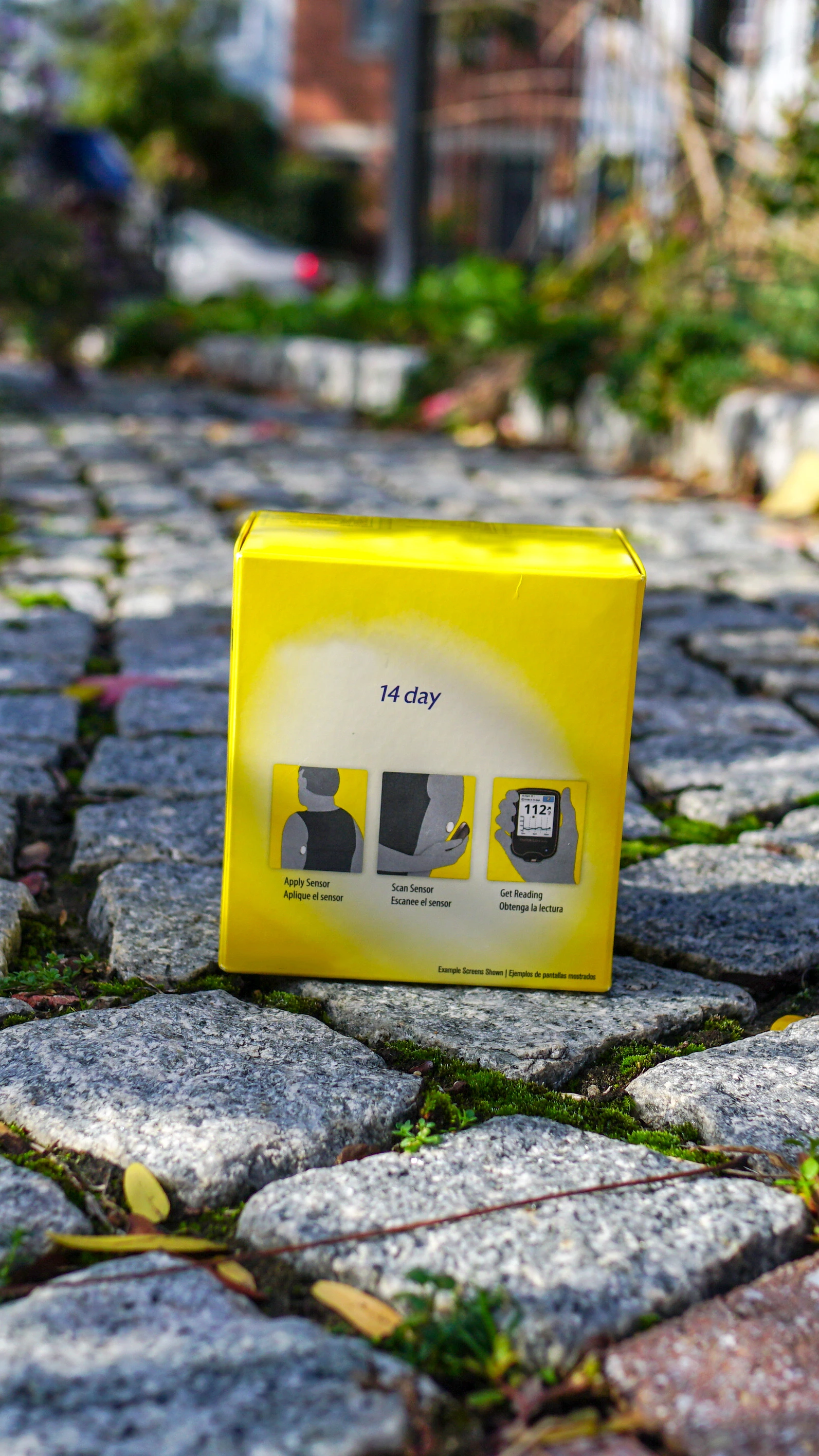
Continuous glucose monitor packaging, photograph by Ted Eytan · CC BY-SA 2.0 · https://creativecommons.org/licenses/by-sa/2.0/

Full frame retained; converted to WebP.