Quiet Zone
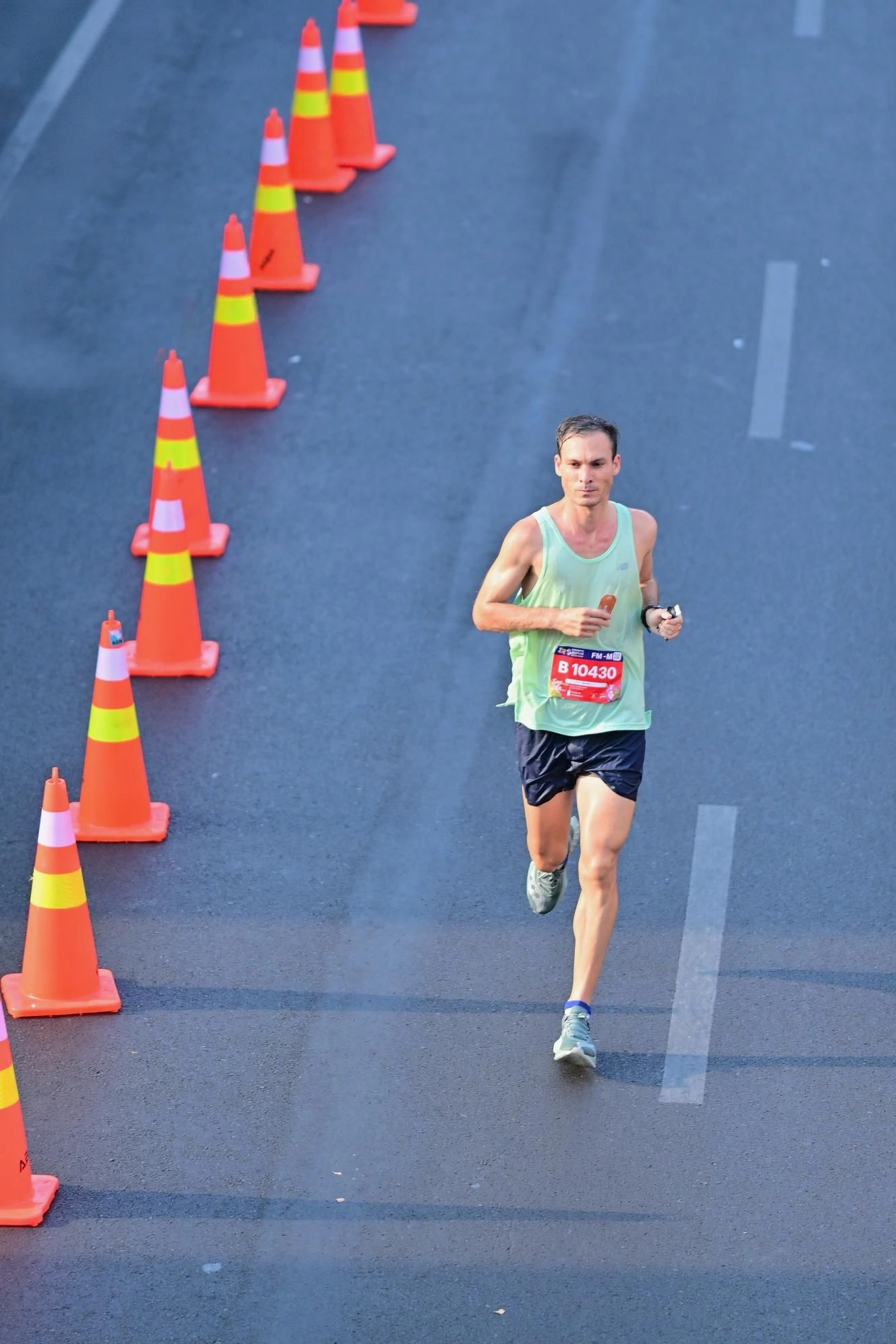
A marathon improvement from 3:37 to 3:17 in four months, with almost no real speed work, makes an appealing headline. The AdvancedRunning report behind it is more interesting when the comparison table and race day stay in view. This runner's hips could not yet tolerate the intensity he wanted, so he worked with the training they allowed.
On 4 October 2026, he finished the Surabaya Isoplus Marathon in 3:17:18. His public report and the discussion below it describe one return after hip surgery. They cannot prescribe mileage or speed sessions for everyone recovering from an operation, or settle how every runner should use Zone 2.
The hip set the terms
He had been a hobby runner since 2017. In his account, an injury during a half-marathon deload week in 2021 kept him from running for about four and a half years. Surgery for hip impingement and a labral tear followed in April 2025. By October that year, monthly mileage was back around 200 km; at roughly fourteen months after surgery, he ran 3:37.
Faster running remained difficult. Speed and lactate-threshold sessions brought stiffness and sharp pain, particularly eight to twelve months after the operation. From about April 2026, he ran almost entirely in Zone 2. His original plan for one marathon and a sub-3:10 changed to B and A races, separated by about sixteen weeks.
His comparison is unusually specific. The B race came fourteen months after surgery, the A race eighteen. Race carbohydrate intake rose from 70 to 90 g/h. B included two painful early threshold sessions; A had none. B had no marathon-pace runs; A had two. Peak four-week average mileage increased from 81.6 to 95.2 km, and the eight-week average from 80.6 to 90.4. B involved four consecutive weeks of hip trouble; A had no comparable stretch. In B, he lost about five minutes over the final 4 km. In A, he felt he executed the race strongly.
The A block originally called for 13, 16 and 19 km at marathon pace inside roughly 31 km Zone 2 long runs, in weeks 6, 10 and 12. A little stiffness after the second, 16 km effort changed that plan. The third became an easy 36 km run, in a peak week of 105 km.
Several things changed together, including time since surgery, mileage and fueling. Credit the whole improvement to the absence of speed work and those variables disappear. Insist on speed sessions as proof of commitment and the hip's response disappears instead.
A four o'clock start
He stopped caffeine for about ten days before the race, hoping to get more from caffeinated gels. That was his intention, rather than a demonstrated result of this report. His Friday and Saturday carbohydrate loads were about 12 and 10 g/kg respectively, with a sodium target of roughly 4500 mg on each day. A one-hour flight took him from Bali to Surabaya; his hotel was about 500 m from the start.
The gun was at 4 am. He went to bed at 10 pm, woke at 12:30 and could not get back to sleep. The original plan was to wake at 3, skip breakfast and take one gel. With unexpected time available, he ate two plain GU gels at 2. From 2:30 to 3, he watched Modern Family in bed, then got ready to warm up.
He recorded 26°C and 82% humidity at the start, describing the humidity as relatively low for his Southeast Asian race experience. There were about 400 marathon finishers; he described himself as the only foreigner. The initial target was around 3:18. Depending on his hips at 20 to 30 km, he might push toward low 3:15 or fall back toward 3:22.
The plan gave his hips time to settle: 6 km near 4:50/km, another 6 near 4:45, then marathon pace around 4:40 from kilometre 12. His chest strap kept slipping. At 12 km it fell completely out of place, and he threw it away.
Between 20 and 30 km came gentle gradients and a stretch of wordless running alongside another racer. From 30 to 36, he pushed toward the low 4:30s. At 39 km, fatigue jumped to a self-rated 9/10. The last 3 km averaged just under 5:00/km. He finished in the top ten, without an age-group award because those awards were limited to Indonesian nationals.
His race plan targeted 90 g of carbohydrate an hour. He carried about eleven gels, took three sodium capsules of 215 mg each, and recorded roughly 440 mg of caffeine in total. Those figures belong to his own race and the fueling he had repeatedly practiced.
One commenter called twenty minutes in four months with almost no real speed work a Zone 2 “cheat code.” Another calculated a dew point near 73°F and wanted no part of that start line. The improvement is striking. So are the conditions and the fatigue in the closing kilometres.
Speed work was still a future hope
Asked about returning after surgery, he described an exercise-science background and following research protocols for return to sport after hip operations. In his reply, he stressed a twelve-to-twenty-month process that could not be hurried. If he could go back, he would skip the attempts at faster paces: he felt they had brought pain without benefit and might have delayed his recovery. That was his reading of his own experience.
By the time of the post, he had run about 2938 km that year. Excluding the marathons, he put speed work, including marathon-pace running, below about 100 km. His estimate was roughly 80% Zone 2, 17% Zone 1 and 3% higher intensity. Zone 2 commonly meant a heart rate of 130 to 135, about 5:40 to 5:50/km, with 600 to 700 m of climbing a week.
He felt physiologically capable of sub-3:10, but still limited by the mechanical support his hips could provide. The comments also touched on caffeine-metabolism genes. Neither that discussion nor his recovery account turns one race into a universal training plan.
After the race, life obligations meant about two months away from structured training, with a return around January. He might skip marathons in 2027 and concentrate on half-marathons and gym work. He still hoped to introduce speed sessions.
Quiet Zone can relieve the pressure to prove commitment through a crowded interval schedule. It can also become another badge of superiority, as if avoiding speed work were proof of better judgment. The useful part of this report is how the runner adjusted to his hip's response and considered goals, fueling and execution together. What belongs in the next training block still depends on the body doing it.
Mert Dinc at the 2026 Surabaya Isoplus Marathon, bib B10430. Photo from the Strava activity linked in his original report. https://www.strava.com/activities/20440363582 · Race report https://www.reddit.com/r/AdvancedRunning/comments/1wy0q0y/337_to_317_marathon_in_4_months_zone_2_club/