The Veto of Residual Heat
If, over the past decade or so, biohacking (actively tweaking sleep, recovery, and nervous-system state with measurable self-experiments) has been drawn in the ordinary evening dictionary as an ever-finer line—on the left, “if the sympathetic system (the alert, heart-rate-up gear) runs too high, add magnesium, ashwagandha, valerian, CBD, and if that fails, heavier sedation”; on the right, “the gym and the sauna are health investments—don’t cut them lightly”—then when one blogger places a schedule of “basic weight training at 4 p.m., sauna at about 85°C (about 185°F) for 15–20 minutes three times a week, sleep at 12:30 a.m.” next to a self-report of being hot, sweaty, AC blasting, heart and mind racing before bed, that line has already broken into two segments: one called stacking a stronger parasympathetic force (the relax, heart-rate-down gear); the other called the veto of residual heat. The image that runs through this discussion is not the next harder sedative, nor a ban that deletes the gym, but how core temperature left by evening heat load (the body’s internal temperature—not whether the skin feels cool) casts a veto over the sleep-onset window—a vote that magnesium and stacks (piling several supplements together) often cannot outvote.
Boundary first: the scenes come from the blogger’s own account and checkable sides of the comment thread. This is not a census of all sleep disorders, ADHD-type brains (the hard-to-stop kind of attention wiring), or all sauna schedules, and still less a clinical prescription. It is useful because it presses “strongest parasympathetic force” and “when should stimulation sit on the clock” from a quarrel into a readable time ledger; it is limited because it covers one person, one stretch of evening overload, a refusal to drop training and sauna, and how a community immediately reweighs “big guns” as “whether residual heat has not yet cleared.”
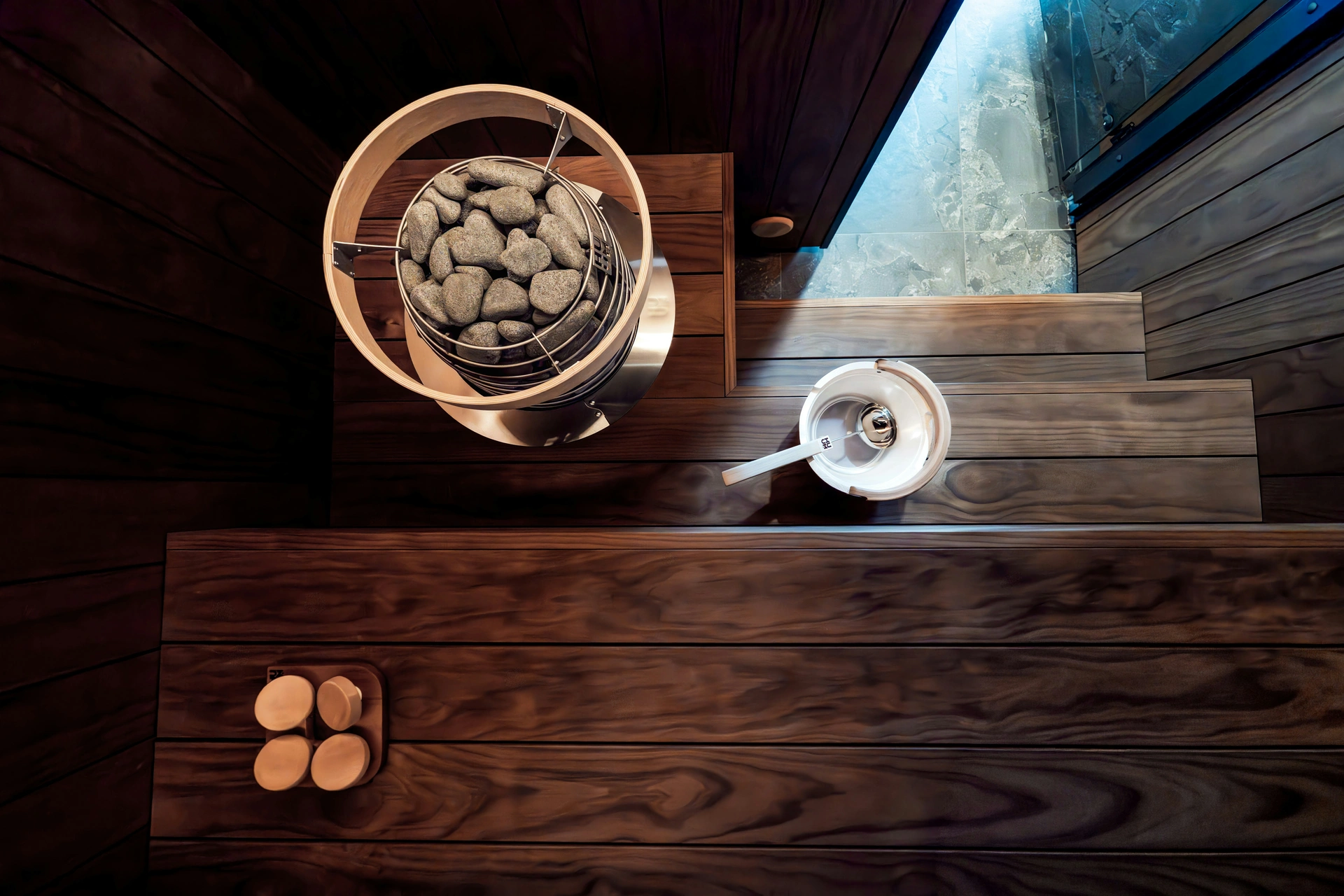
Sauna stove and benches. Heat itself is not the enemy; evening residual heat can still cast a veto over sleep onset.
Default logic: ask for the strongest parasympathetic force, then fill the table with bottles
Industry default likes to write “can’t sleep” as a supplement-and-gadget manual: take magnesium; try ashwagandha, valerian, CBD; lay out an acupuncture mat; run a cooling bed pad; do breathwork. The default holds in many shop windows and biohacking groups—until you open the blogger’s question. He writes: since adding a little gym and sauna, his nervous system is far too jacked before bed; hot, sweaty, AC at full blast, heart rate and mind racing together. He has always been wound a little tight: sweaty hands and feet, an ADHD-type brain, hypersensitive to caffeine; otherwise he considers himself quite healthy—stress and diet fine. He does not want to remove the gym or the sauna; he does not think he is overdoing it—basic weight training at 4 p.m., sleep around 12:30 a.m.; sauna about 85°C for 15–20 minutes, three times a week. What he wants is clear: rather than cut physical stimulation, find a way to rapidly and strongly push the body into a parasympathetic state and lower heart rate—because the body stays elevated too long into the evening.
The tension in this section is not “supplements are useless,” but how the default ranking tips its hand. Default assumes calming agents will automatically outrank stimulation; the scene says—for this person, magnesium, ashwagandha, valerian, and CBD are often not strong enough, and the only heavy gun that works is Valium (a prescription sedative); acupuncture mat, cooling pad, and breathwork have all been tried. The closing ask is blunt: what do you feel is the strongest thing that will rapidly force a parasympathetic state and lower heart rate? He wants big guns, or something more creative.
The default is tempting precisely because “one more bottle” looks serious, controllable, and immediately buyable. Moving the sauna to the morning, or ending the session before 6 p.m., looks crude: it is just moving the clock. Crude is often harder to sell—and harder to admit—because admitting means the veto is not on the shelf but on the temperature curve.
Hand holding a dumbbell. The blogger keeps 4 p.m. basic lifting and refuses to drop the gym; stimulation is treated as a health investment to keep.
How the comments reframe “big guns”: timing, core temperature, and a free lever
If the blogger sets the key with “strongest parasympathetic force,” the comments immediately hand back harder conditional sentences. One commenter is direct: timing is probably the whole thing. Sauna spikes core temperature and sympathetic drive; the body needs core temperature to drop before it will allow sleep. Evening sauna means fighting that signal. This commenter moved sauna to at least three to four hours before bed and saw a large difference; a lukewarm shower afterward (not hot) helps dump heat faster. For the acute wired feeling: slow breathing with a longer exhale—say four in, six to eight out—for a few minutes lying down pulls the foot off the sympathetic gas pedal; cadence often matters more than depth.
A longer comment sharpens it further: you are asking for the strongest way to force a parasympathetic state, but reading the schedule, this looks like a timing problem wearing a nervous-system costume—and timing is free. Fifteen to twenty minutes at about 85°C is a serious cardiovascular stressor; core temperature stays elevated for hours; the body needs a core-temperature drop to initiate sleep. If any sauna lands in the evening, you are not failing to calm down—you are physiologically blocking the sleep-onset signal and then trying to override the block with magnesium. No supplement out-argues core body temperature. Before adding anything new, run a real experiment for two to three weeks rather than stacking more calming agents: morning sauna only, or immediately post-workout ending before 6 p.m., and finish every session with a properly cold shower—the rebound cooling is what flips you parasympathetic; skip it and you stay in the “hot, AC on, heart racing” state described. Do not judge by feel—feel is what has been lying (“wired” can read as energized or anxious by the hour). Judge by overnight resting heart rate (RHR) and heart-rate variability (HRV) trends, plus time-to-fall-asleep. If evening heat was the problem, overnight RHR often moves within days of shifting the schedule. If the numbers do not move, you have ruled timing out and can escalate with a clear conscience. The same comment names another cheap lever on ADHD wiring: a racing mind at 00:30 is partly circadian. Strength training at 4 p.m. is fine, but check the last two hours—screens, bright light, and mentally engaging content hold an ADHD brain in sympathetic mode better than any sauna. Dim + boring + fixed wake time is unsexy and outperforms most of the calming stack. The pattern pushed back gently: adding downers to cancel stimulation instead of scheduling stimulation where it helps. Subtraction-and-timing experiments are less satisfying to buy, but they are the ones that keep working.
What this section actually weighs is not a final verdict on magnesium, but how the community takes a “need big guns” ask apart into parts you can still question: whether the residual-heat veto is still active, whether a three-to-four-hour buffer is enough, whether a lukewarm shower is dumping heat, whether the experiment window watches feel or overnight numbers. Default likes to cast pushback as “afraid of intensity”; the scene says—in this thread, reframing “strongest parasympathetic force” often starts by admitting the temperature curve holds a veto.
A clinical thermometer. Comments keep nailing the discussion back to core temperature: no supplement out-argues “sleep onset needs temperature to fall first.”
Other weighings: sodium and sweat, earlier training, screens, and a night-owl boundary
If the timing story is easy to misread as “just move the clock and done,” other comment weighings widen the ledger. One commenter asks: are you replacing sodium lost in workout and sauna sweat? The system that conserves sodium is linked to the stress system in general; a heavy sweater may lose a gram or more of sodium in an hour of hard exercise, and with sauna still more; conventional low-sodium advice may not fit heavy sweating—sports physiology has studied this closely. Another suggests moving weight training earlier; a rough idea floated is that muscle repair carries something like an eight-hour half-life feel—the body is still working when you want to sleep. Magnesium glycinate is named as a calmer form; there is speculation about chronic anxiety or trauma history and seeing a therapist who knows ADHD skills (such as 4-7-8 breathing)—speculation, not a diagnosis. Cold plunge after sauna to cool the core, with equal time spent relaxing; electrolytes before, during, and after; avoid eating for a couple of hours after an intense session so core temperature can fall; dim lights an hour before bed; physiological sigh breathing—these appear side by side, but this essay will not center another shelf stack (phosphatidylserine / glycine and the like). The axis stays timing versus residual heat.
The blogger’s own replies nail a boundary so the talk does not slide into “then just gym at 5 a.m.” He writes: no apnea on three tests; he is an extreme night owl with delayed sleep phase (DSPS)—a chronotype set to stay up late; years of 6 a.m. wakeups never felt good, and he tried all the biohacks of the time—biology simply said no. Long evening walks; cigar / nicotine use could be better; more bloodwork planned. A commenter pulls the cigar thread: nicotine raises heart rate and adrenaline in the same direction as caffeine; cigars deliver it through the mouth lining whether or not you inhale. Another bluntly says “gym at 5 a.m.”—for someone with a DSPS boundary, that slogan easily miswrites “movable stimulation” as “must become a morning person.” What is worth keeping from the scene is not a moral trial over bedtime, but: without dropping training and sauna, which clock levers still move; which “just wake early” slogans hit a chronotype wall already tested for years.
A dimly lit bedroom. Comments cast the last two hours of screens and bright light as a lever that can hold an ADHD-type brain in sympathetic gear harder than sauna.
Closing: redefine recovery independence—not buying stronger downers, but holding the residual-heat veto and the hours you can still move
If biohacking culture often reads independence as “buy the full calming stack before anything else” or “believe big guns are a master key,” this discussion sits closer to another independence—holding at once the veto of residual heat and “stimulation can change clock position,” and seeing which bill “strongest parasympathetic force” is actually asking for. The public thread is worth public prose because the checkable scene is on the table: lifelong tightness, sweaty hands and feet, ADHD-type brain, caffeine hypersensitivity; evening overload worse after adding gym and sauna; 4 p.m. lifting, 85°C sauna 15–20 minutes three times a week, sleep at 12:30; refusal to drop either; magnesium / ashwagandha / valerian / CBD / acupuncture mat / cooling pad / breathwork tried, Valium as the heavy gun that works; the ask for strongest parasympathetic force; and the comment chorus on a three-to-four-hour buffer, lukewarm heat dump, core temperature out-arguing supplements, a two-to-three-week morning-or-before-6 p.m. experiment with cold-shower rebound, judging by overnight RHR / HRV / time-to-sleep, dim-and-boring last hours, sodium and sweat, earlier training and magnesium glycinate, cold plunge and electrolytes, DSPS night-owl boundary, nicotine that could be better, another blood test planned.
The value of the discussion is that it does not push only “everyone should stop sauna at once” or “supplements are all a tax on intelligence,” but returns recovery to: first tell “stack more downers” from “residual-heat veto,” then tell “the clock that works for me” from “copy someone else’s wake-at-6 slogan,” and, with the veto of residual heat and the free timing lever, still polish that layer inside the rising tide of “big guns must be stronger” and “healthy habits must never move”—the hard part of independence often hides in whether you still treat the next sedative bottle or a “just wake at 6” line as your only body history, not only in the next easier “science has proven” or the next brighter “my stack is complete.”
An actionable tip stays plain: treat evening heat load as a veto that must clear, not as a cue to buy a heavier downer at once. If you still keep afternoon lifting and sauna, first ask whether the session ends at least three to four hours before sleep, and whether lukewarm or cold water afterward helps core temperature fall—then ask whether to add the next herb. Run two to three weeks changing only clock and shower; watch overnight RHR, HRV, and time-to-sleep, not only “how tonight feels.” In the last two hours before bed, treat screens and bright light as a sympathetic switch, especially if you call your brain ADHD-type. Book sodium and sweat on their own line; do not copy sports-physiology needs into a low-salt dogma. With a DSPS boundary, separate “movable schedule” from “must become a morning person”: side evidence is not a license. Write “calm” as “holding your own residual-heat veto”—allow supplements to help and still lose to temperature at once; allow “keep training and sauna” and “evening residual heat can block sleep onset” at once; the real danger is mistaking “strongest parasympathetic force” for a master key that can ignore the core-temperature curve, or mistaking “health investment” for a bar that can ignore the clock—not “always outsourcing to the next harder sedative” or “always outsourcing to the next brighter just-wake-early.” A timer can hold one day’s line; the veto of residual heat is still written, before the bottles fill the table, in whether you honestly noted that the body is still casting a no-vote for heat from hours ago. People who hold both the veto and the movable hours at least know which lever they are measuring: the shelf, or the temperature curve.
The content of this article is only for viewing, reflection and independent judgment. It is not an instruction manual. It is simply a part of what exists in the world.
HUUM · Unsplash License · https://unsplash.com/license
Full original frame converted to WebP; aspect ratio retained.