Second Sunrise
He left Corte at 23:00 on Thursday and returned at 08:52 on Saturday. The result was 112 km, 7,128 metres of climbing, 33 hours 52 minutes, and 173rd place. There was a medal and a finisher shirt, but no finish-line video. His timing chip had stopped working; the organisers recorded his result by hand.
The public ultrarunning race report stays with you for its less polished details: two blankets that did not stop the shivering, a borrowed jacket, and a final descent after a second sunrise. Those details explain what “just finish” had come to mean. This account draws on the report and its comments. It describes one runner’s preparation and decisions, not a training prescription for everyone else.
From Mont Blanc to Corsica
The blogger had long enjoyed trail running and fast-packing, including GR20 and GR54. In 2024 he circled Mont Blanc in four days and caught the atmosphere just after UTMB. He writes that the connection drew him in: he wanted to work towards longer ultras. About a month later, on the UTMB website, he found Ultra-Trail di Corsica, part of Restonica Trail: roughly 110 km and 7,000 metres of climbing, with Running Stones to collect.
Preparation took eight or nine months. His half-marathon personal best had recently improved to 1:45. He began with about four months of Runna marathon training, running five times a week, then followed its 100 km Elite Plus plan from March to July. Peak weeks reached about 120 km. He also did CrossFit three to five times a week throughout the year. That is a record of his preparation, not a weekly mileage target to lift out of context.
At 23:00 on Thursday, Corte’s streets were full of flares and red light, with something of a stadium atmosphere. About 450 runners set off. He wore bib 464, allocated by UTMB Index. It was his first night start, and the headlamps formed a line climbing into the dark.
Padule, around 7 km in, already meant more than 1,300 metres of climbing. He reached it after about two hours in 218th place. At Boniacce, around 15 km, he was 186th; at Calacuccia, around 33 km, he was 167th after 6:14. Near 40 km and seven hours, he briefly imagined finishing in twenty-one hours. His ideal target had been twenty-four, the Index estimate about 26:30, and his main goal simply to finish.
His previous highest-climbing race had involved about 3,000 metres of ascent. Halfway through this one, he had already passed 4,000.
When the target times fell away
The climbs became harder, his legs heavier on the descents. Bunions made his shoes pinch. At Ballone, a volunteer reminded him that his bib had to be displayed on his chest or he could face a penalty. He admits that, at the time, he just wanted to be left to keep moving.
He had hoped to reach the Ciattarinu life base, around 60 km, near noon. He arrived after about fifteen and a half hours of racing. The target times were slipping away. He changed shoes, showered, ate pasta and waited out the storm. People discussed whether to sleep. He had been awake for about thirty hours and chose to continue. Afterwards, pain developed on the inside of his right knee; he later thought it was closer to the pes anserinus than the outer IT band. That was his interpretation of the pain, not a diagnosis.
Inzecche came at roughly 74 km and twenty and a half hours. Fuel had shifted to Coke, solid food and Naak waffles. The second night began. His earbuds had broken after the storm, so on empty stretches he played his phone at the lowest volume from his chest pocket, switching it off near other people. A commenter criticised the speaker. He replied that he had used earbuds for most of the race and resorted to the phone only after they failed. The criticism and the explanation both belong in the account; a difficult finish does not settle questions of trail etiquette.
He met Spanish runner Xavi and later descended with Austrian runner Dominik. Bocca a Soglia, around 85 km, came at 25:06. Some of the descent involved sliding on his backside, and one carbon pole snapped. At Grotelle, around 89 km, he was 176th after 26:30. One last climb of about 750 metres remained.
He reached Alzu, around 99 km, after 30:03 in 167th place. Even wrapped in two blankets, he was shivering. The organisers sent Picard a WhatsApp asking whether he had withdrawn: his chip had not registered since Inzecche. A volunteer confirmed by radio that bib 464 was there. Someone joked that water from the soft flasks might have killed the chip. Xavi’s friends lent him a warm jacket.
The twenty-one-hour thought was a long way behind him. Blankets, a jacket and people who could confirm where he was mattered much more now.
The descent after dawn
After the second sunrise, he headed down from Alzu towards Corte: about 10 km and 1,300 metres of descent. Tree shadows looked like animals, rocks like cabins. He had to stare at the details to recognise the illusions. Local morning runners called out that only two or three kilometres remained; he found that reassurance a little too cheerful. Only after reaching town did he start running again.
At 08:52 on Saturday, he finished in 33:52, 173rd, with 112 km and 7,128 metres of climbing behind him. He received the medal and shirt. With the chip broken, the result was entered manually and the usual finish video was missing.
Days later, at the airport, he met Lars, a Belgian runner with twenty 100 km races and a UTMB finish behind him. Lars described this course as exceptionally hard and technical, especially for a first long ultra. That gave the experience some perspective without turning every difficult moment into a heroic necessity.
The comments also raised a useful distinction. When the blogger wrote “100M”, he meant the UTMB Index category, not a course measuring one hundred miles. He explained that the grouping takes distance and climbing into account and includes some races around 100 km and above. One reader was struck by his choice of such a demanding first race; another planned to fly from Australia precisely to find more technical trail. The same route can answer very different ambitions.
Time goals still matter, and preparation deserves scrutiny. But twenty-four hours alone cannot explain this race. “Just finish” cannot excuse every decision either. The blankets and the failed chip do not diminish the finish; the medal does not make everything that preceded it a model to follow.
The useful kind of independence here is being able to describe both the original ambition and the limits encountered along the way. Keep the medal, and remember the borrowed jacket. Both belong in deciding what to attempt next.
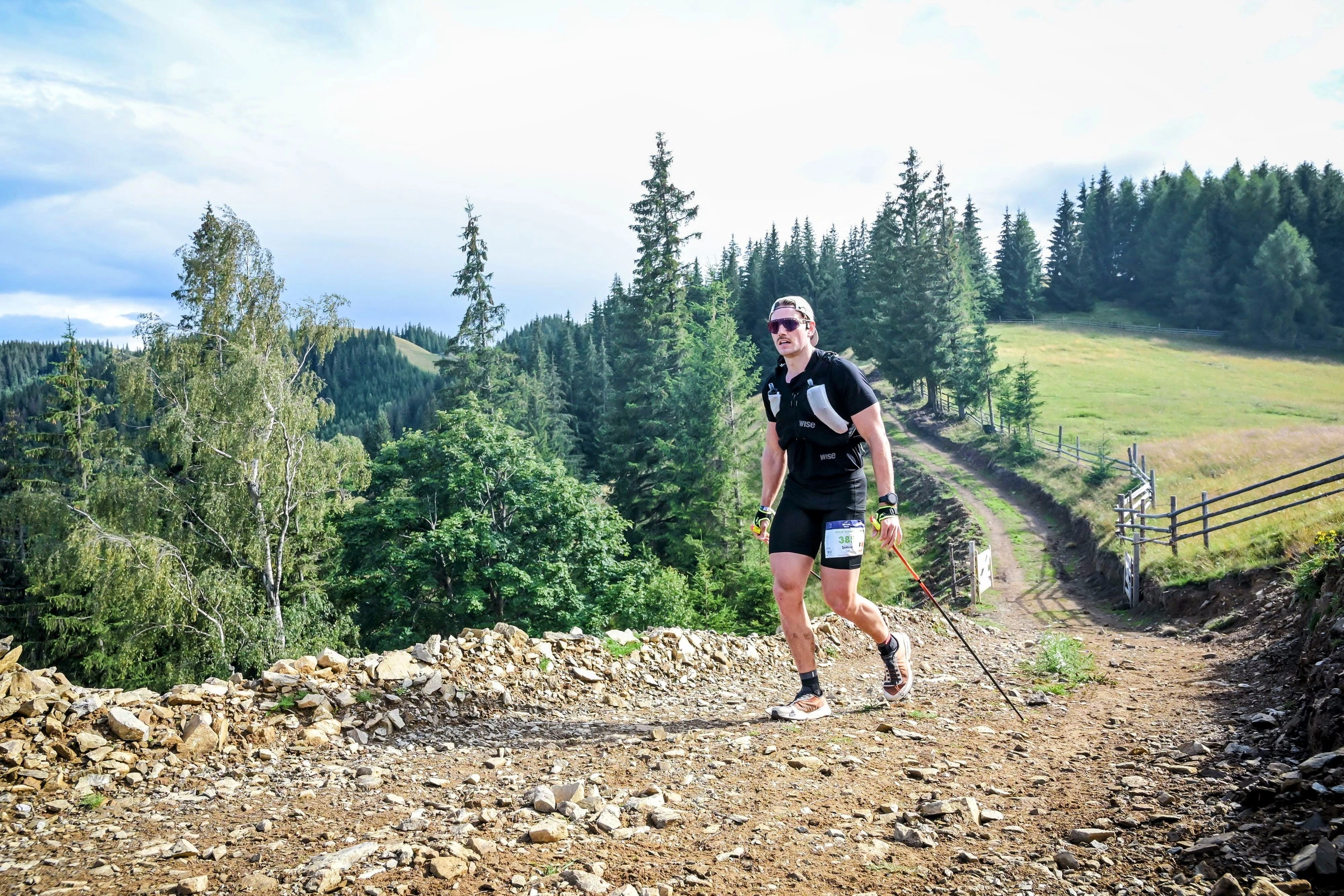
Simon Picard at Bucovina Ultra Rocks in 2026, from his race report; not the Corsica race described here. https://www.simonmyway.com/fr/blog/bucovina-ultra-rocks-courir-un-ultra-de-bout-en-bout · WebP, full aspect ratio. · Race report https://www.reddit.com/r/ultrarunning/comments/1m5gysg/ultratrail_di_corsica_my_first_100m_race_race/