Another Measure of Sleep: Regularity
If the past decade-plus of mass sleep and biohacking culture still drew its spectrum as a straight line—on the left, “seven to nine hours a night equals sleep health”; on the right, “sleep scores, mouth tape, and supplement stacks are the real optimization entry”—then once someone laid UK Biobank data from about sixty thousand people and more than ten million hours of accelerometry on the same table, that line had already folded into a pair of shears: one blade the tide of rhythm, how regularity can out-predict duration for mortality; the other the knife-edge of duration, still cutting score-worship with the scene of “enough sleep, yet shifted by ninety minutes.” The image that runs through this essay is not the next dearer melatonin stack, but the tide of rhythm and the knife-edge of duration: on one side, Sleep Regularity Index (SRI) tides that associate with about twenty to nearly forty-eight percent lower all-cause mortality risk; on the other, a comment section almost in chorus—the worst mornings are often not the shortest nights, but the nights that still logged seven and a half hours while bedtime moved ninety-plus minutes.
From the “duration grail” to “regularity predicts more strongly”: how the default is peeled open
What the poster did was plain: reshare a prospective cohort study in SLEEP (2024) whose title already carries the edge—sleep regularity is a stronger predictor of mortality risk than sleep duration. The paper is by Windred and colleagues; the sample is about 60,977 UK Biobank participants, more than ten million hours of wrist accelerometry; mean age about 62.8, women about 55%; median SRI about 81.0. After accelerometer wear, follow-up ran up to about 7.8 years; 1,859 deaths; about 4.84 per 1,000 person-years. Higher sleep regularity versus the least-regular quintile: all-cause mortality risk about 20%–48% lower; cancer mortality about 16%–39% lower; cardiometabolic mortality about 22%–57% lower—after adjustment for age, sex, ethnicity, and sociodemographic, lifestyle, and health factors. Most-regular quintile (80–100th) versus least-regular (0–20th): minimal-model HR ≈ 0.52; fully adjusted ≈ 0.70. Regularity and mortality show a monotonic relation; duration looks more U-shaped in the minimal model and more linear when fully adjusted. By AIC, regularity models fit all-cause mortality better than matched duration models (minimal p < .001; fully adjusted p = .005). In nested models, adding duration on top of SRI adds limited extra explanation.
This story is familiar in biohacking circles, and also sharp enough to sting. Industry default likes to write “seven to nine hours” as a grail, or “sleep score” as an optimizable dashboard; the post peels the default open not by inventing a third slogan, but by pressing scenes into the concrete—the same checkable numbers: the regularity tide cuts mortality risk more sharply than the duration edge; duration still signals, yet in nested comparison looks more like an outcome than a lever. One highly upvoted commenter puts it cleanly: regular sleep helps circadian rhythm, so no surprise. Another maps the data onto their own body: after locking wake time to about ±30 minutes (weekends included), resting heart rate dropped a few beats and HRV jumped less; the wake anchor matters more than bedtime, and bedtime self-corrects once the anchor holds—if you get only one lever, pick a wake time you can keep seven days and hold it; consistency beats chasing a perfect eight hours every time. The poster’s own replies soften the tone: consistency seems key; eight hours still feels good; the study lists known physiological effects of circadian disruption among reasons for the finding.
So the default shows its seam—it thought a “duration number” could convert losslessly into “sleep health” or a “longevity-stack entry”; the post and thread rewrite it with the same checkable clash: regularity is written as the stronger predictor; duration remains, yet more like flotsam in the tide than the half-inch of knife you can pull each day.
Input and outcome: why the same 7.5 hours still cuts like a knife after a 90-minute shift
One long comment almost awkwardly mirrors the paper’s mechanism. The commenter writes: regularity is the input the circadian system can actually use; duration is an outcome, bouncing with stress, training load, alcohol, and life chaos. A stable sleep/wake window is the lever you can pull every day. Lived test: the worst morning is not the shortest night, but the night bedtime shifted ninety-plus minutes while sleep still hit 7.5 hours—same duration, utterly different recovery signal. After weeks of fixed wake time (weekends included), overnight metrics smoothed while average duration barely moved.
That sentence drags the through-image from “did I sleep enough” back to “did an input reach the circadian system”: the tide can raise the duration number and still fail to cut the knife-edge of a twisted rhythm. Another commenter wonders how much reverse causality and confounding sit here—illness itself making sleep irregular—which matches the paper’s limits: one week of accelerometry is a snapshot; covariates are not synced to the recording; the sample skews older and relatively ethnically homogeneous; association is not causation; fully adjusted models may include mediators. The essay need not pretend association is causation; it only needs to set the pair side by side: the monotonic lowering of mortality risk with the regularity tide, and the half-inch of knife still needed for “which came first.” The thread also carries a half-inch joke that uses a diagnostic label to tease “as if measuring longevity in a certain population”—usable as tone, not expanded into label judgment.
For people who already treat “eight hours” as a grail, the paper’s HR ranges quench thirst; for people who already treat supplement stacks as the entry, the long comment’s split of input and outcome quenches more. So the through-image falls from “tide of rhythm” to “the knife still in the sheath until you tell input from outcome before drawing half an inch”: the question is not only how many hours, but whether the circadian system receives a stable daily timestamp; not only raising a score, but whether the same duration is still self-made jet lag.
Weekend jet lag, shift work, and buried wearable scores: the half-inch the biohacking stack does not see
The long comment’s executable list is hard: anchor wake, not bedtime; the consistency/regularity metrics buried in wearables are what this study says predict mortality; weekends are where regularity dies—shifting Saturday by two hours is roughly self-made jet lag, about a hundred times a year; watch downstream markers (two-to-four-week resting-heart-rate trends) rather than sleep scores. It also names what makes biohacking circles uncomfortable: the highest-ROI sleep intervention is free, boring, and zero-product—so it gets less airtime than mouth tape and supplement stacks.
That half-inch asks cleanly. Industry default shows its seam again: it assumes the optimization entry must be a purchasable stack; the post and thread spread priorities open—the free wake anchor, the buried regularity metric, whether weekends manufacture jet lag may sit closer to the variable the paper measured than the next bottle. Shift-work comments read bitter: someone only replies “nice to read lol”—the industry-default contrast scene sits right there: for people who can choose their sleep/wake window, regularity is a lever; for shift workers, the same tide reads like a knife pressed onto the calendar. Another comment notes that optimal-duration numbers fight each other across studies, perhaps because there is no group optimum; regular bedtime, by contrast, is a consistently positive signal. The wrist itself speaks—sleep score lit, consistency buried in menus; the tide written on the wrist, the lab and cohort written in accelerometers and follow-up.
The knife’s half-inch lives in these cracks: whether two weekend hours equal about a hundred self-made jet lags a year; whether wearables hide the mortality-predicting metric on a secondary screen; whether supplement stacks steal attention that belonged to the wake anchor; whether shift reality makes “free intervention” sound like another privilege. The essay need not adjudicate everyone’s roster; it only needs to admit: the default thought “enough sleep” and “buy the stack” could cover sleep health; the post and thread rewrite it with cohort numbers and lived scenes—the tide of rhythm often dies on weekends, while the knife-edge of duration often pretends it already suffices.
Closing: rewriting “independence” as holding both the tide of rhythm and the knife-edge of duration
If mass sleep culture often reads independence as “one person guarding eight hours a night” or “one person stacking sleep supplements,” this discussion is closer to another independence—holding both the tide of rhythm and the knife-edge of duration, refusing the false binary. The post’s value is that it lays checkable scenes on the table (UK Biobank accelerometry tides, the monotonic SRI–mortality relation, AIC favoring regularity over duration, limited extra explanation from nested duration). The thread’s value is that it does not shove the poster into “duration is useless” or “regularity slogans only,” but returns the spirit of the rule: first tell input from outcome, then wake anchor from bedtime; use whether weekends manufacture jet lag, regularity metrics buried in wearables, and two-to-four-week resting-heart-rate trends to keep polishing that edge inside the rising tide of score-worship—sleep’s difficulty often hides in whether you can give the circadian system a stable daily timestamp, not only in the next sleep score or the next bottle.
Executable prompts are plain: anchor wake time (weekends included) and let bedtime self-correct, rather than first chasing a perfect eight hours. Open the regularity/consistency metrics buried in the wearable and treat them as closer to this study’s variable than the sleep score. Manufacture less weekend jet lag—Saturday’s two-hour shift is not “catch-up virtue,” more like a repeating yearly knife. Watch two-to-four-week resting-heart-rate trends rather than single-night score tides. Write “independence” as “reading both blades of rhythm and duration yourself,” not “forever outsourcing to the next brighter supplement” or “forever outsourcing to the cheaper line that enough sleep is enough.” The paper’s limits remain: snapshot, association, sample structure—the half-inch of knife is admitting these, not turning HR intervals into personal fate verdicts. Whoever holds tide and knife at least knows which lever they are pulling.
The content of this article is only for viewing, reflection and independent judgment. It is not an instruction manual. It is simply a part of what exists in the world.
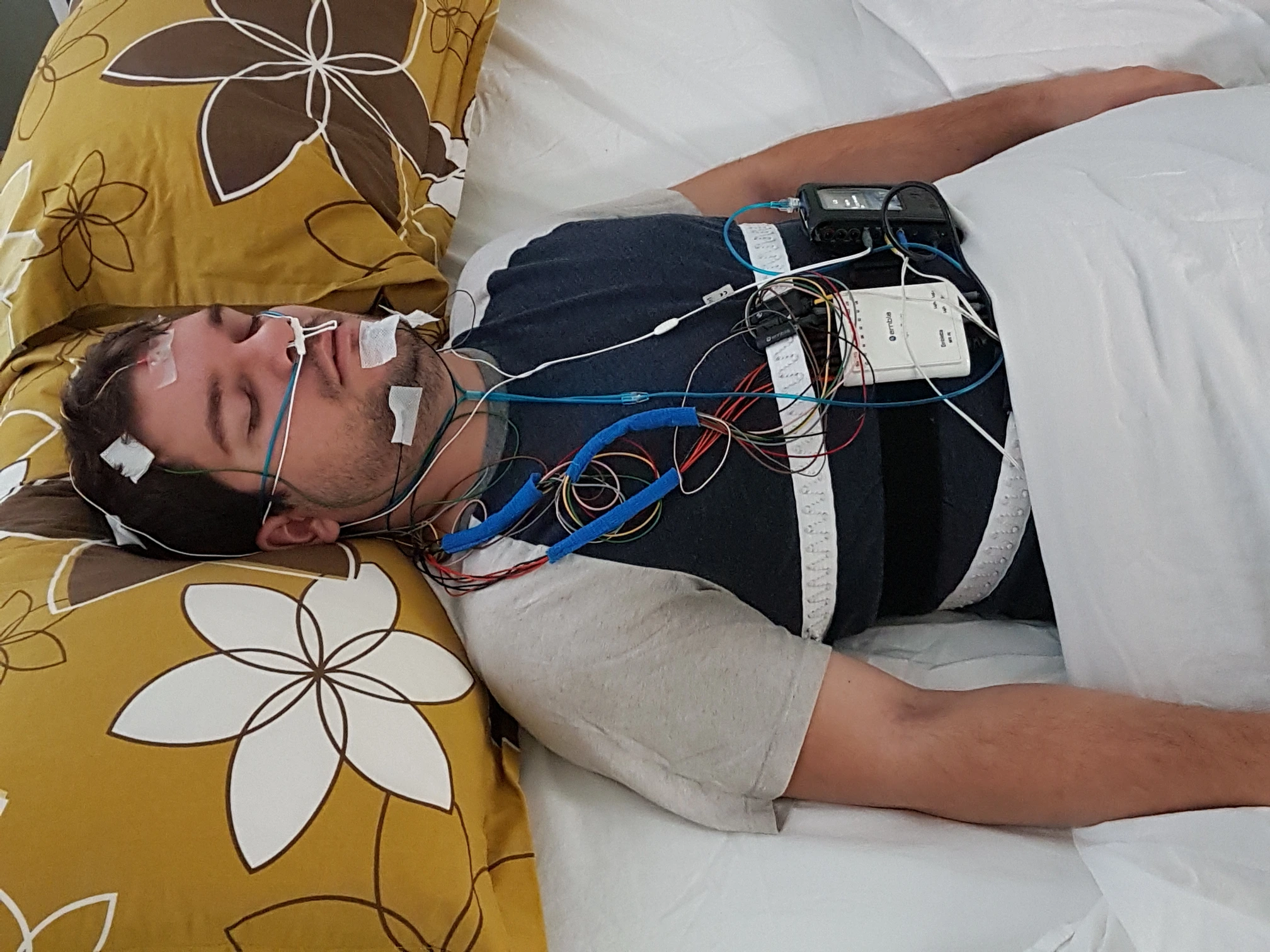
Demonstration of polysomnography equipment, photograph by Clinique Somnomed · CC BY-SA 4.0 · https://creativecommons.org/licenses/by-sa/4.0/
https://commons.wikimedia.org/wiki/User:Clinique_Somnomed
https://commons.wikimedia.org/wiki/File:Polysomnography_model.jpg

Full frame retained; converted to WebP.