Sticky Hand
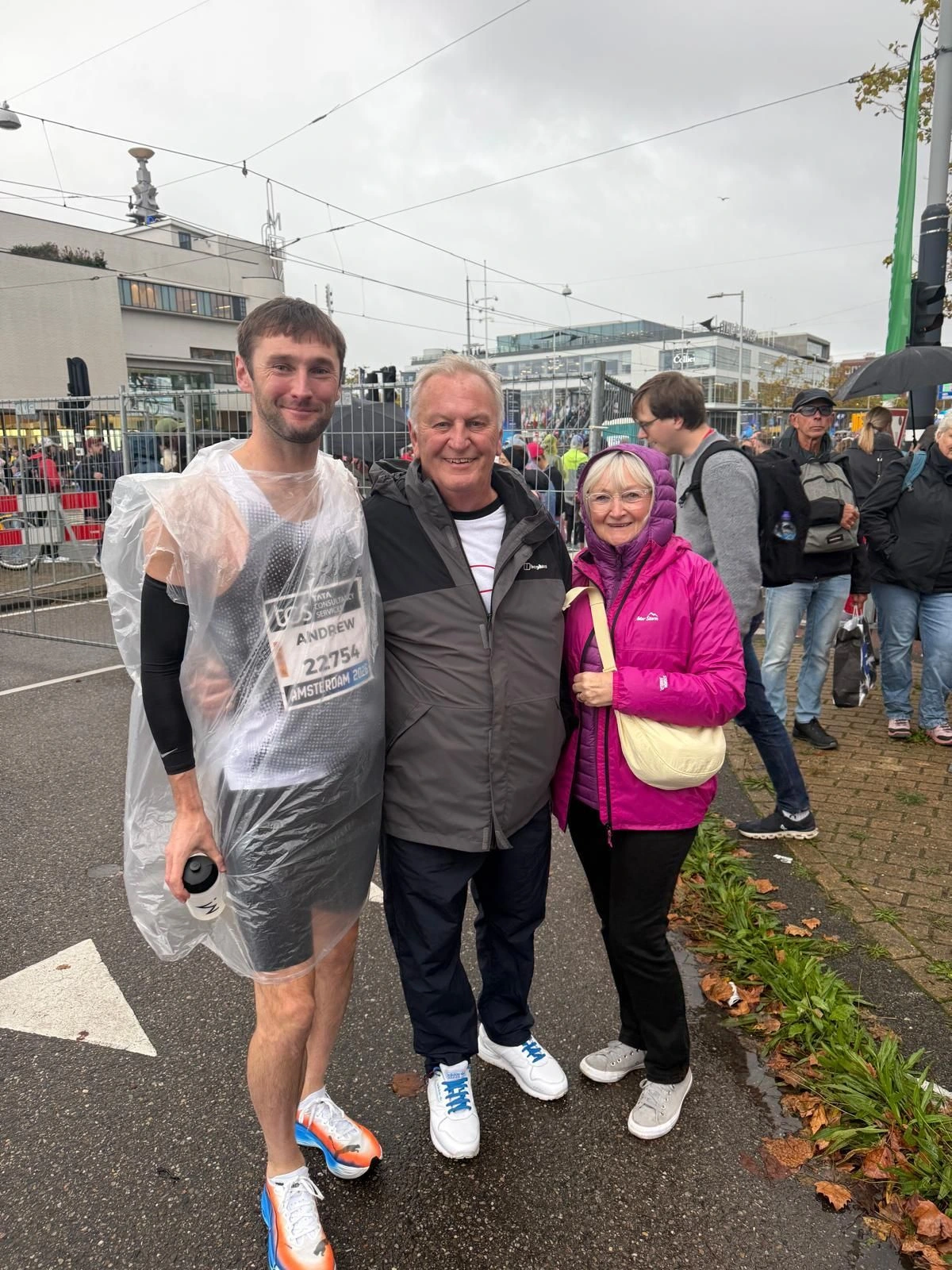
At the first aid station in Amsterdam, he poured most of the Maurten drink over his hand. After running the next stretch with sticky fingers, he decided to stick to his own gels. Fuelling practice had not prevented a small race-day mishap. He left it in his report alongside a finishing time of 3:01:31.
I checked the public race report behind this account. Its author describes himself as a 39-year-old man weighing about 73 kg, running the Amsterdam Marathon on 18 October 2026. He recorded 42.54 km. Sub-three was missed; sub-3:05 and a personal best were achieved. Compared with his previous 3:37:23, he had improved by roughly 36 minutes, yet his title still called it a big PB but not quite a “true BQ”. That is his description of the Boston qualification question; the report supplies no cutoff that should be invented here.
A large improvement and an unfinished ambition can coexist. So can an aid-station mistake and a race worth celebrating. The training and physical sensations below are his account, not a plan for someone else to copy through pain.
Giving it a proper go
He returned to running in 2024. His 2025 bests were 19:50 for 5 km, 42:06 for 10 km, roughly 1:31 for the half and 3:37 for the marathon, with about 1,455 km run that year. For his first marathon in Valencia he followed Hanson's plan, but injury and illness led him to abandon the time goal and concentrate on finishing. Amsterdam entries opened about a week later. He wanted to give it another proper go.
After reading Pfitz early in the year, he built from January to June towards five running days and about 35 miles a week, with long runs of 13 to 14 miles. A 1:04:38 ten-mile race in April gave him encouragement through VDOT: sub-three might be within range if the next block went well. He began the 18/55 plan in June while deliberately aiming to cap the biggest weeks at around 50 miles.
The first two marathon-pace sessions felt “absolutely brutal”. Other runners' experiences on the forum helped him trust the process. After the second, a niggle appeared behind his knee. He says his physio found no clear problem; he spent a week cross-training on the bike before returning gradually. In August the physio suggested nerve flossing. His next 10 km best was 39:31, over a minute quicker in eight weeks despite barely running in the preceding fortnight. Those events belong to his account, without establishing that one exercise caused the improvement.
His third marathon-pace run averaged around 4:19/km, and his half-marathon best came down to 1:30:04. Before the taper he completed two 32 km runs. In the second, the final 26 km averaged about 4:18/km, with the last two kilometres at 4:11 and 4:06. A good taper, carbohydrate preparation and race-day excitement made sub-three feel possible, although 3:02 to 3:05 remained his more sensible target. Weddings and stag parties overlapped the final three weeks; he ran four days a week and shortened the taper by a week.
Thirty seconds behind
Getting there was awkward. EasyJet cancelled the Glasgow flight to Amsterdam. A replacement journey via Stansted was delayed, leaving about 40 minutes of a planned two-hour connection. Garmin recorded roughly 2 km through the airport at 4:20/km, which he counted as a shakeout. He reached the hotel around 11 pm, about seven hours late.
Race morning was cool and wet. He carried six Maurten 160 gels, intending to take one every 6 km. After the drink spilled at the first station, he relied on his own fuel. Along the Amstel, roughly between kilometres 13 and 26, the wind picked up and the path narrowed to four or five runners abreast. Going wide to pass cost distance; sitting behind a group cost time.
Halfway came in 1:31:35, about 30 seconds behind what he had hoped. He stayed patient rather than trying to recover it immediately, planning to reassess at 32 km. Returning towards the city around 30 km, he still felt strong, but slowing for water kept giving back some of the time he gained.
At 35 km he was at about 2:31. Sub-three now demanded close to 4:00/km for the remaining 7.2 km. He felt willing to push, but his splits were not getting much faster. Other runners were stopping with cramp, including some who had recently passed him. In the final underpass his left hamstring began to ache. He decided to protect the race he had.
That decision belongs beside the result. He had looked at the pace required and noticed what his body was doing. Preserving a substantial improvement required judgment too.
Beyond the finish
Through Vondelpark and towards the stadium, recognising the size of the coming PB gave him another push. He finished in 3:01:31. A friend filmed the closing stretch; watching it afterwards, he found the difference between how fast he felt and how slow he looked comical.
While stretching against a fence, he started crying. He described it as emotion, or perhaps endorphins. Opening his eyes, he found an event cameraman pointing straight at his face. He walked away and met another finisher in a similar state. They hugged, exchanged a few words on the way towards the medals, then went their separate ways.
The supplied snapshot recorded about 47 upvotes, seven comments and a 0.91 upvote ratio, including three congratulations that could be checked. Readers praised the race and the write-up. One of a similar age found the improvement encouraging. Celebration did not require the runner to erase the disappointment in his title.
His own review was practical: practise aid stations and lose less time on overpasses and underpasses. He averaged around 50 km a week across the block and felt there was aerobic development left. Next came cross-country and shorter races, with speed sessions back in training. He intended to use Pfitz again, first building towards a point where 55-mile weeks felt less daunting, then using shorter-race results to shape the next marathon target.
There is room in that account to keep wanting sub-three and to value the race already run. The sticky hand and the decision after 35 km remain part of a 36-minute improvement. Another race offers things to work on. This one still deserves its celebration.
The author with companions after the Amsterdam Marathon, from the Strava activity linked in his original post. Andrew McKenzie / Strava · https://www.strava.com/activities/20636790768 · resized / WebP