A First 100-Miler, a Western States Record
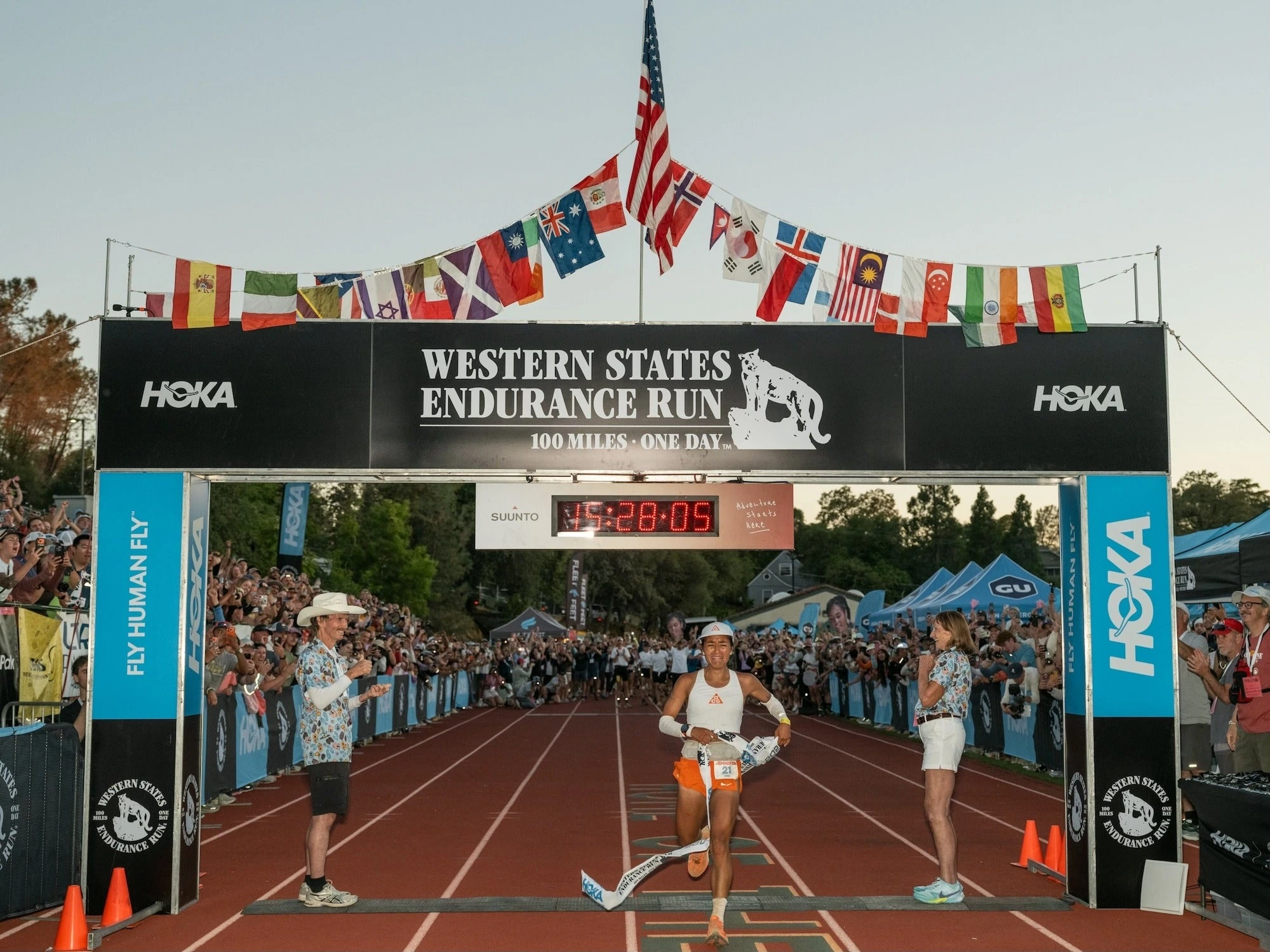
If the past decade-plus of hundred-mile trail culture still drew its spectrum as a straight line—on the left, “pay tuition first, stack multiple hundreds, then you may touch a course record”; on the right, “deep fields and paid systems are the real breach entry”—then once the 53rd Western States 100 (about 100.2 miles, Olympic Valley to the Auburn Placer High track) closed on 27–28 June 2026, that line had already folded into a pair of shears: one blade the tide of first passage, how a first-ever hundred can be written as a women’s course record; the other the knife-edge of the record, still cutting cool-year weather and a deep field with execution after Devil’s Thumb, in the river-crossing duel, and in the last mile. The image that runs through this essay is not the next dearer Golden Ticket or the next easier slogan of an “experience threshold,” but the tide of first passage and the knife-edge of the record: on one side, Jennifer Lichter (also Jenn Lichter) peeling the default open—thirty years old, Missoula, Montana; first hundred, win, about 15:28:05 / 15:28:06 (sources differ by about a second), breaking Courtney Dauwalter’s 2023 mark of 15:29:33 (roughly eighty-five to eighty-eight seconds faster); on the other, recaps and comment threads almost in chorus—a cool year and a finish rate near eighty-seven percent are a tide, not an automatic knife; the edge still sits in whether you dare push at the decisive moment, and whether you can read the duel.
From “experience threshold” to “first-passage record”: how the default is peeled open
What the poster did was plain: reshare a CTS Western States 2026 recap—its title already carries checkable numbers and scenes—while the comment section slid quickly toward coaching fees and “system myth.” The essay need not become a price rant; it only needs to press the scenes concrete. The WSER official Race Recap, iRunFar results, and Runner’s World / Canadian Running summaries lay the same checkable clash on the table: women’s winner Jennifer Lichter, first hundred, win and record; second Riley Brady 15:42:14 (third-fastest ever); third Marianne Hogan 15:51:44. The men’s side is equally sharp—Vincent Bouillard 13:46:15, breaking Jim Walmsley’s 2019 mark of 14:09, the first sub-fourteen; Francesco Puppi about 13:51, Ryan Montgomery about 13:53, others also under the old record. About 18,000 feet of climb, about 22,000 of descent; start near 51°F, finish high about 73–74°F, far below a historical mean near 90°F; 322 of 370 finishers, finish rate about 87%, historically high.
This story is familiar in trail circles, and also sharp enough to sting. Industry default likes to write “pay tuition on hundreds first” as a threshold, or “multi-race experience” as the precondition for touching a record; the post and recap peel the default open not by inventing a third slogan, but by pressing scenes into the concrete—the same checkable numbers: before the race Lichter had already broken the Black Canyon 100K record in February at 7:57:05 for a Golden Ticket, and broken a Gorge Waterfalls 50K record; here she deliberately shelved her usual front-running for more restraint. The CTS piece also notes coach John Fitzgerald: steady control early, push at the decisive moments; nine CTS athletes in the men’s and women’s top tens—usable as a “system / first passage” contrast, without turning into soft advertising. So the default shows its seam—it thought “years of experience” could convert losslessly into “license to touch a record”; the recap and results rewrite it with the same checkable clash: the first-passage tide can raise a record, yet the knife still sits in post-halfway execution, not only in the résumé column on the entry form.
Duel and canyon knife: the half-inch after Devil’s Thumb
The decisive scenes almost awkwardly mirror the course profile. Around Devil’s Thumb (about mile 47.8) Lichter took the lead; before that, a duel with Riley Brady. At the river crossing (about mile 78) Brady closed to about two minutes; by mile 85.2 the gap opened to about seven; at Robie Point the lead on the record was about a minute; the last mile had to be bitten into the record. That sentence drags the through-image from “first-passage myth” back to “is the half-inch of knife still underfoot”: the tide can raise a cool year and a deep field and still fail to cut the edge of whether you dare push, whether you can read the duel. For people who already treat the “experience threshold” as a grail, a first-passage record quenches thirst; for people who already treat paid systems as the entry, early control and a late push quench more. So the through-image falls from “tide of first passage” to “the knife still in the sheath until you tell tide from execution before drawing half an inch”: the question is not only which numbered hundred this is, but whether after Devil’s Thumb you still read yourself inside the duel; not only whether cool weather automatically gifts a record, but whether, with about a minute on the record at Robie Point, the last mile still dares to bite. Riley Brady and Ryan Montgomery are noted as non-binary by iRunFar—Chinese (and this English) can keep full names and skip pronoun guesses; what is recorded is time and duel, not label judgment. On the men’s side Bouillard / Puppi / Montgomery cutting the fourteen-hour edge is likewise not a scene a “system slogan” can automatically cash: the tide is written in weather and finish rate; the lab is written in the last mile’s feet.
Cool-year tide and system myth: the half-inch first passage does not see
Weather extremely cool: start near 51°F, finish high about 73–74°F, far below a historical mean near 90°F; finish rate about 87%, historically high. That half-inch asks cleanly. Industry default shows its seam again: it assumes a record must first stack years of experience, or must be outsourced to the next brighter “system myth”; the post and thread spread priorities open—the cool-year tide lifts finishes and field depth, yet the knife still sits in Lichter’s restraint after shelving front-running, the lead after Devil’s Thumb, and whether a duel closed to two minutes at the river is still readable. Comment threads talk coaching fees at length—a light touch on “first-passage myth vs paid system” is enough: on one side, the tide-scene of a first hundred as course record; on the other, deep fields and coaching systems written as breach entries. The essay need not expand into a price rant; it only needs to admit that the default thought “experience” and “paid system” could cover license to break a record, while the recap rewrites it with checkable results—the first-passage tide often dies in “one more tuition race,” while the knife-edge of the record often pretends a cool year already suffices.
For people who can freely choose seasons and recovery windows, tickets and systems are levers; for people who treat “run several hundreds before talking records” as discipline, the same tide reads like a knife pressed onto the calendar. The dial itself speaks—finish rate lit, whether you dare push at the decisive moment buried in menus; the tide written in start and finish temperatures, the knife written in the seven-minute gap at mile 85.2 and the last mile with about a minute on the record at Robie Point. The knife’s half-inch lives in these cracks: whether cool weather equals an automatic record; whether first passage equals “no system needed”; whether paid systems steal attention that belonged to reading the race and restraint; whether the duel makes the “experience threshold” sound like another privilege. The essay need not adjudicate everyone’s race calendar; it only needs to admit: the default thought “multi-race experience” and “buy the system” could cover license to touch a record; the post and recap rewrite it with official results and lived scenes—the tide of first passage often dies in “wait one more,” while the knife-edge of the record often pretends it already suffices inside field depth.
Closing: rewriting “independence” as reading both blades—first passage and record
If trail culture often reads independence as “one person pays enough tuition before touching a record” or “one person outsources to the next brighter paid system,” this discussion sits closer to another independence—holding both the tide of first passage and the knife-edge of the record, refusing the false binary. The poster’s value is laying checkable scenes on the table (WSER official recap, iRunFar results, CTS notes on early control and decisive push, cool-year finish rate and deep field); the thread’s value is not reducing the talk to “are coaches expensive” or “first-passage myth solves everything,” but speaking the rule’s spirit back: first tell tide from knife, then tell experience threshold from half-inch of execution, and with the duel after Devil’s Thumb, the close at the river, and whether the last mile still dares to bite, keep polishing that edge inside the rising tide of “cool year / system myth”—the hard of a hundred often hides in whether you can read both blades of first passage and record, not only in the next Golden Ticket or the next easier “run a few more first.”
The executable prompt is plain: read results and the course profile, rather than chasing the résumé number of “which numbered hundred.” Treat cool weather as tide conditions, not as a voucher automatically cashed for a record. Treat systems and coaches as checkable contrasts of control and decisive moment, not as soft-ad entry or fuel for price rant. Watch the duel at decisive miles and the last mile, not only finish rate and field depth. Write “independence” as “reading both blades—first passage and record yourself,” not as “forever outsourcing to the next experience race” or “forever outsourcing to the next brighter system slogan.” Source limits remain: finish seconds differ by about a second across outlets, recap angles differ—the knife’s half-inch is admitting these, not writing first passage as a personal fate verdict. People who hold tide and knife at least know which lever they are pulling.
Jennifer Lichter finishing the 2026 Western States 100, photograph by Nick Presniakov
Suunto · https://us.suunto.com/blogs/news/jennifer-lichter-wins-western-states-100-mile-endurance-run